Turf colorant for golf courses: recolouring greens, fairways and tees
A turf colorant for golf gives a green tint back to tees, greens and fairways yellowed by drought or dormancy, with no extra watering. Greeneclat is diluted at 1:30 on dormant turf, needs 8 hours without rain and dries in under 2 hours. It colours the grass that is there and replaces neither water nor overseeding.
On a course, the question arises mainly in summer, when drought orders cut back watering, and sometimes in winter, when turf goes dormant. In both cases, the yellowed grass generally stays alive. The colorant serves to present a green course during that period.
Under water restrictions, fairways turn yellow first
The national guide to implementing restrictions, published by France's ministry in charge of the environment, sets minimum measures for golf course watering:
- Alert: watering banned from 8 am to 8 pm and volumes reduced by 15 to 30%.
- Heightened alert: watering banned, except for greens and tees, with volumes reduced by at least 60%.
- Crisis: watering banned, except for greens, with a ceiling of 350 m³ per week per 9 holes, between 8 pm and 8 am, unless drinking water is short, and a reduction of at least 80% of usual volumes.
These are minimums: your département's framework order can be stricter, and the orders in force are published on VigiEau. In practice, fairways lose their water from heightened alert, then tees at crisis level.
Turf deprived of water goes dormant. Its leaves yellow, but the plant survives. The Ontario Ministry of Agriculture states that turf can stay dormant in summer for four to six weeks without adverse effects, and that it greens up seven to ten days after rain returns. Beyond that, losses are possible.
What golf courses already do with colorants
In the United States, colorants have become the common alternative to overseeding bermudagrass during winter dormancy, according to the NC State Extension guide (North Carolina State University). The same publication states that they are also used on cool-season grasses during a drought, or to tone down a mottled look after summer or winter stress, on golf courses as on sports grounds. In France, kikuyu and Bermuda grass in the South also turn yellow in winter: our article on kikuyu grass yellow in winter covers them.
The recommendations of the USGA, the United States Golf Association, are practical:
- start when growth slows but the turf is still green, because fully yellowed turf needs higher rates for the same look;
- calibrate the sprayer and cross passes in two directions to avoid streaks;
- limit traffic, especially carts, and rotate access points.
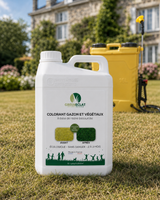
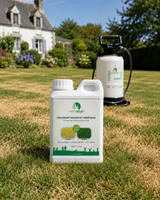
On a course, people often talk about golf turf paint. The term covers very different products. Greeneclat is a colorant made of organic pigments, a 98% bio-based plant resin and water: the blades stay alive and the colour goes with the mowing. Our page grass paint: what the term covers explains the difference.
Recolour the areas people see first
Recolouring a whole course rarely makes sense. The areas that matter for image are limited:
- tees, seen close up by every player, on small areas;
- the practice putting green and the clubhouse surroundings, also seen by visitors and restaurant guests;
- fairways, starting with the holes visible from the clubhouse or the road;
- roughs, which can be left to yellow: they generally green up again when the rain returns.
For areas where the grass is dead, autumn overseeding remains the right answer. For winter, our article on yellow lawns in winter dormancy covers the approach on smaller areas.
Dosage, shade and quantities on a course
| Area and condition | Dilution (concentrate : water) | Coverage |
|---|---|---|
| Dormant or very yellow fairway | 1:30 | 200 m² per litre |
| Moderately damaged tee, patchy areas | 1:40 | between 200 and 400 m² per litre |
| Green still green, to even out | 1:50 | up to 400 m² per litre |
For one hectare of fairway, our calculator gives 5 containers of 5 L Pro on turf that is still healthy and 10 containers on very yellow turf. For a professional, the material cost with concentrate is around €0.10 to €0.15 per m², as an order of magnitude.
Meadow Green, light, is the default shade for golf courses and greens. Forest Green, deeper and matt, suits very yellow fairways and the dry south of France. The two can be mixed to approach the colour of your watered areas. The guide which shade to choose helps you decide, and a photo sent to our team is often enough.
Application on a course
- Mow before application.
- Choose a window of 8 hours without rain and switch off the automatic irrigation for the area during that window.
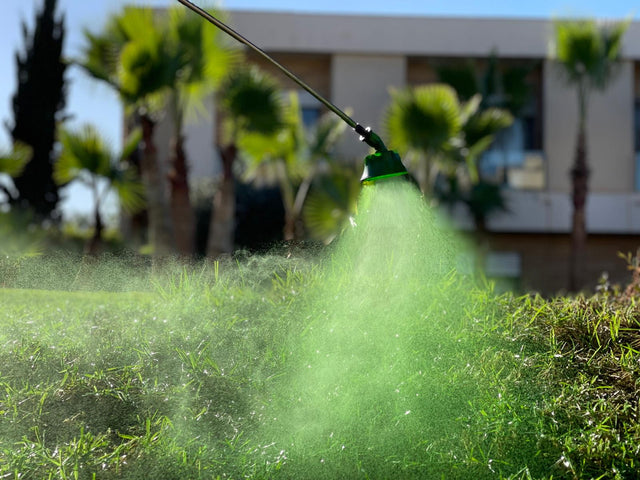
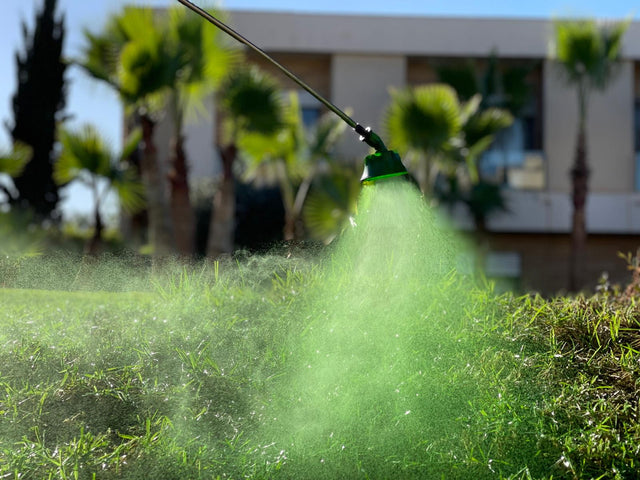
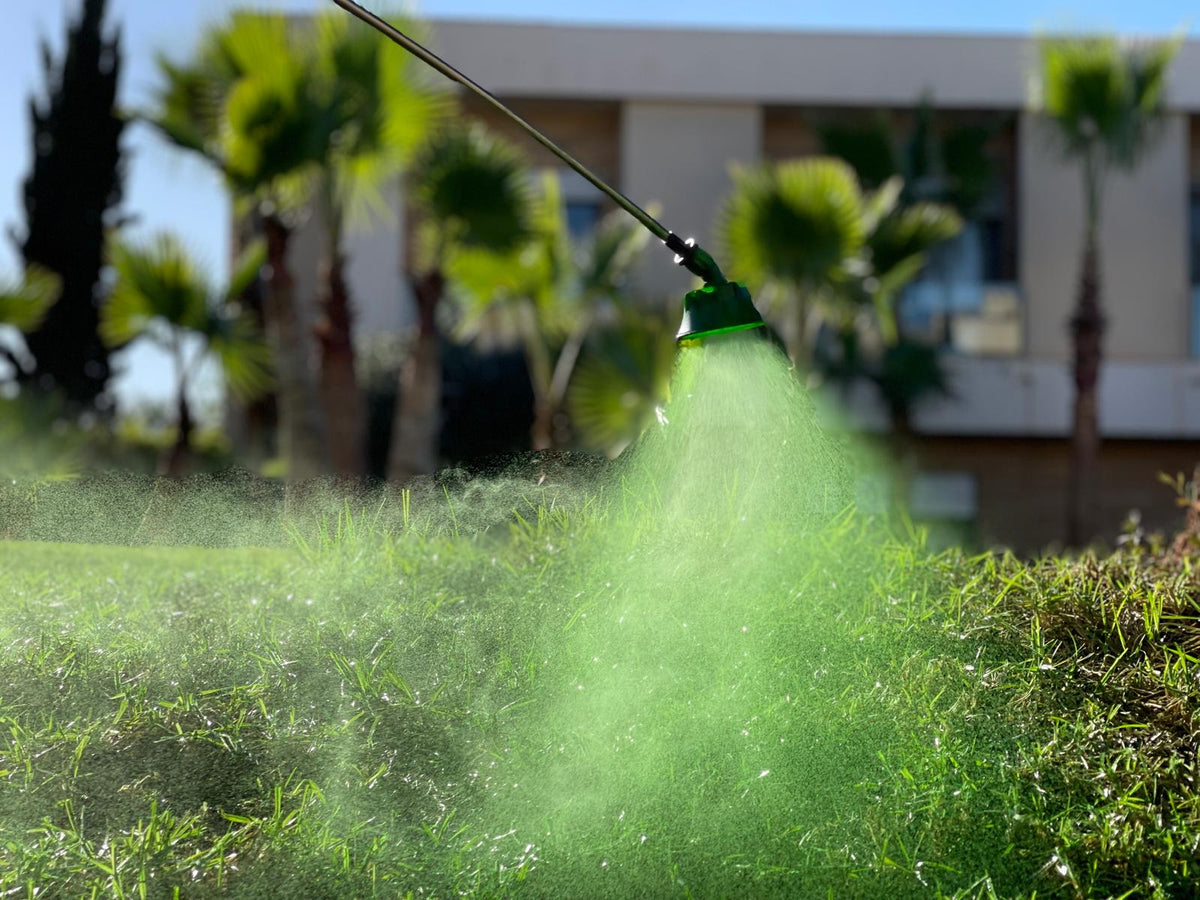
- Dilute according to condition and spray with a boom or lance in criss-cross passes. Equipment is covered in which sprayer to apply a lawn colorant.
- Close the area to players and carts during application and drying: under 2 hours in usual conditions, 2 to 3 hours in summer. Once dry, the product is safe for people and animals.
- Judge the shade once dry, then adjust the dilution on the next hole if needed.
The limits to know before starting a programme
How long it lasts depends on mowing. On turf, the colour goes over 2 to 3 months with mowing. A green mown very short and almost daily loses it faster than a fairway. Plan a trial and a reapplication rhythm for each area.
Ball roll has not been measured. We have no published measurement of the effect on green speed. Run a trial on the practice putting green, with a Stimpmeter reading before and after, before treating the course greens.
Colour does not protect the turf. The USGA points out that colorants bring neither new leaves nor wear resistance: traffic on dormant turf damages it, coloured or not. On bare areas, sand and soil remain visible.
Greeneclat is not a plant protection product. It recolours without treating. Since 1 January 2025, the ban on plant protection products in France has extended to golf course tees, greens and fairways, with a list of exempted uses for official competitions. Greeneclat treats no disease and replaces no turf protection solution. Nor is it a fertiliser or a biostimulant.
Frequently asked questions
Does the colorant change green speed?
We have no published measurement on this point. Before treating the course greens, run a trial on the practice putting green with a Stimpmeter reading before and after application. A 1:50 dilution in two light passes is the most cautious starting point on a green that is still green.
Can the colorant be applied to turf in winter dormancy?
Yes, it is one of the intended uses: on dormant turf, the dilution is 1:30. You need 8 hours without rain after application. In damp weather, drying can take longer than the usual 2 hours: choose a dry day with no dew forecast just afterwards.
Can players play straight after application?
As soon as the area is dry: under 2 hours in usual conditions, 2 to 3 hours in summer. During application and drying, the area stays closed to players, carts and animals. Once dry, the product is safe for them.
How long does the colour last on a fairway?
On turf, the colour goes over 2 to 3 months with mowing. A fairway mown several times a week will lose it faster than an ornamental lawn. A trial on one hole, followed for a few weeks, gives the reapplication rhythm for your course.
Request a trade price for your course
Golf terms are not published: they depend on areas and volumes. The format suited to courses is the 5 L Pro Meadow Green concentrate, also available in Forest Green. Send us the areas to be treated and a photo of a tee and a fairway from the page Request a trade price: we will come back to you with the shade, dilution and quantities.