Grass paint: why choose a lawn colorant
What is commonly called grass paint is, at Greeneclat, a colorant: a pigmented liquid that you dilute and then spray on grass that is yellowed but alive. The blades keep growing, with no plastic film, and the colour goes with the mowing over 2 to 3 months. One litre of concentrate covers up to 400 m².
This page brings together what you need to know before recolouring a lawn or a hedge: what the word covers, when recolouring makes sense and when it is better to reseed or wait, how to apply it, what it costs per square metre, and the product's limits.
"Grass paint": what are we talking about?
When a lawn yellows, people readily type "grass paint", "lawn paint" or "green grass paint". They also talk about painted grass or painting the lawn. The idea is always the same: giving a green colour back to grass that has faded, without waiting for rain and without watering more.
The word has stuck because the action looks similar: you spray a green liquid. What really counts, though, is the composition, and in particular the binder, the ingredient that fixes the colour on the blade. Greeneclat spent 18 months of research replacing a petrochemical binder with a plant resin. The formula comes down to three components: organic pigments, a 98% bio-based plant resin, water.
The result is a colorant based on a plant resin. The colour settles on the blade, the blade stays alive and keeps growing, and the shade gradually goes with the mowing. That is why we talk about a colorant, even though we know many people are looking for a paint.
Lawn paint or colorant: what to check before you buy
Whatever the name on the label, six questions let you judge a product for recolouring a lawn. Here are the answers for Greeneclat; you can ask any manufacturer the same ones.
| Question to ask | Answer for Greeneclat |
|---|---|
| Does the grass stay alive? | Yes. The blades keep growing; no plastic layer forms on the surface. |
| What happens to the colour when you mow? | It goes with the cut blades. Allow 2 to 3 months on a lawn. |
| What is the formula made of? | Organic pigments, a 98% bio-based plant resin, water. |
| What does the safety data sheet say? | No pictogram, no CLP classification element, a safety data sheet free of any hazard, available on request. |
| How far does one litre go? | Up to 400 m² on healthy lawn, 200 m² on badly burnt lawn or on hedges. |
| How long does the colour last on a hedge? | 6 to 12 months on hedges, thujas and boxwood, which are not mown. |
The full comparison is in our guide lawn paint or lawn colorant: the difference, and the buying criteria in what to check before you buy.
When to recolour your lawn
Recolouring makes sense when the grass is yellowed but present, and a green look matters now. It is not always the right answer: a yellow lawn in summer is most often dormant, and it will green up again with the rain. Accepting it remains the most frugal option. The cases where a colorant really helps:
- A yellow lawn after a drought. When watering is restricted, or you refuse to spend drinking water on appearance, recolouring avoids watering for looks alone: up to 80% less water on treated areas (internal study). See yellow lawn: causes and fixes, lawn burnt by drought and watering restrictions.
- A yellow lawn in winter. Dormant turf is recoloured with a more concentrated dilution (1:30). See yellow lawn in winter.
- Dog urine spots. The 750 mL ready-to-use spray recolours more than 100 spots. It does not prevent new ones: see yellow dog urine spots.
- Fertiliser burn. If the grass has yellowed without dying, it can be recoloured; if it is dead, you need to reseed. See fertiliser burn on the lawn.
- Hedges, thujas, cypresses, boxwood. The colour lasts 6 to 12 months. Only living parts can be recoloured. See thuja turning yellow or brown, hedge paint for thujas and yellow or dull boxwood.
- A day that matters. Viewings of a house for sale, a wedding, a reception: see selling your house and a green lawn on the big day.
- Professionals. Landscapers, golf courses, sports grounds, local authorities: a service in a single visit; Greeneclat is not a plant protection product: it recolours without treating. See professional lawn colorant, golf: greens and fairways, sports pitches and local authorities and green spaces.
Conversely, an area where the grass is dead is reseeded or overseeded: the colour binds to a living blade, not to soil. Nor is the colorant used on vegetable patches, edible plants, flowering plants, moss, mulch or wood.
How to apply a colorant to your lawn
Application takes about as long as mowing. The detailed instructions are in how to paint a yellowed lawn: step by step; here are the essentials.
- Choose the right day. You need 8 hours without rain after application. Check the forecast before you start.
- Mow first. Mown, dry grass gives a more even result.
- Dilute according to the state of the grass. The yellower the surface, the more concentrated the mix (table below). A 1:30 dilution means 1 volume of concentrate for about 30 volumes of water. The ready-to-use formats are poured in as they are.
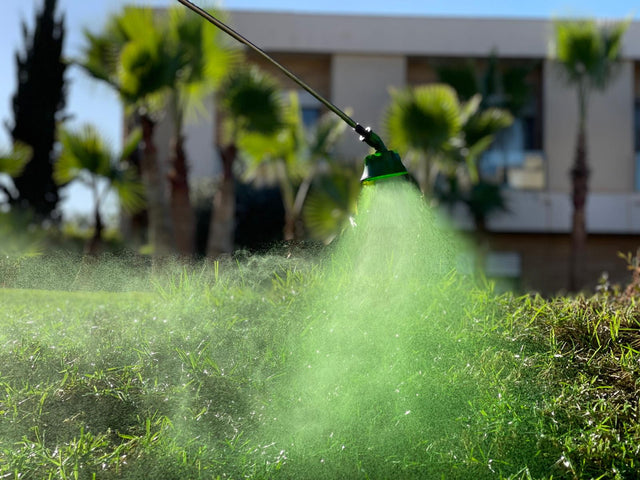
- Spray in criss-cross passes. A trigger sprayer is enough for spots; beyond a few square metres, a pressure sprayer saves effort and gives an even spray. See which sprayer to choose.
- Let it dry. Under 2 hours in usual conditions, 2 to 3 hours in summer. Children and pets stay away during application and drying.
- Judge once dry. Two light passes are better than a single overloaded one.
| Condition of the surface | Concentrate dilution |
|---|---|
| Badly burnt, bleached or dormant turf, thujas, boxwood | 1:30 |
| Moderately damaged turf, patchy areas | 1:40 |
| Turf still green, young lawn, simply evening out | 1:50 |
To know how much product to buy, start from the area and the state of the grass: 400 m² per litre on healthy lawn, 200 m² on badly burnt lawn or on hedges. The step-by-step calculation is in how much colorant for my lawn.
Is it dangerous for children, the dog or the grass?
Once dry, Greeneclat is safe for children and pets. During application and drying, keep them away. On the regulatory side: no pictogram, no CLP classification element, a safety data sheet free of any hazard, available on request.
For the grass, the colour binds to the blade, with no plastic film: the lawn keeps growing, you mow it as usual, and each mowing removes part of the shade. The details are in lawn paint: is it dangerous?
How much does grass paint cost per m²?
The cost per square metre depends on the format, the price paid and the state of the grass. The figures below are calculated with the prices shown on our product pages as of 4 November 2026, assuming the container is used in full.
| Format | Price incl. VAT | Area treated | Cost per m² incl. VAT |
|---|---|---|---|
| 750 mL ready-to-use spray | €32.99 | about 10 m² | €3.30 |
| 5 L ready-to-use container | €49.99 | about 50 m² | €1.00 |
| 500 mL concentrate | €69.99 | 200 m² (healthy lawn) or 100 m² (badly burnt) | €0.35 or €0.70 |
| 1 L concentrate | €89.99 | 400 m² (healthy lawn) or 200 m² (badly burnt) | €0.22 or €0.45 |
| 5 L Pro concentrate | €359.99 | 2,000 m² (healthy lawn) or 1,000 m² (badly burnt) | €0.18 or €0.36 |
If your area is smaller than the container covers, the real cost goes up: for 300 m² of healthy lawn, a 1 L concentrate comes to €0.30 per m². At trade prices, the concentrate comes to about €0.10 to €0.15 per m²; volumes are quoted on request. Comparisons with overseeding or turfing are in lawn paint: what it costs per m².
Which format to choose
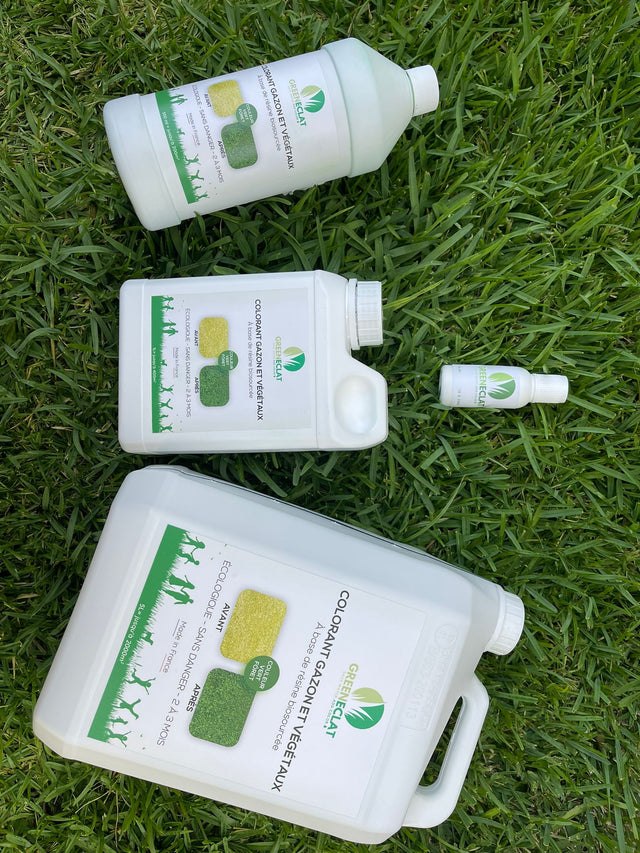
Every format comes in both shades. Delivery is free from the 1 L (France) and orders leave within 48 hours.
| Format | Use | Coverage | Price | Product pages |
|---|---|---|---|---|
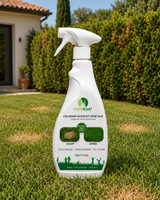
| 750 mL spray, ready to use | urine spots, edges, touch-ups | about 10 m², more than 100 spots | €32.99 | Meadow Green spray · Forest Green spray |
| 5 L container, ready to use | small garden, first try, no measuring | about 50 m² | €49.99 | 5 L ready-to-use Meadow Green · Forest Green |
| 500 mL concentrate | medium garden, hedge | up to 200 m² or about 100 m of hedge | €69.99 | 500 mL Meadow Green concentrate · Forest Green |
| 1 L concentrate | whole lawn, several hedges | up to 400 m² | €89.99, free delivery | 1 L Meadow Green concentrate · Forest Green |
| 5 L Pro concentrate | landscapers, golf courses, pitches, large parks | 1,000 to 2,000 m² | €359.99, free delivery | 5 L Pro Meadow Green · Forest Green |
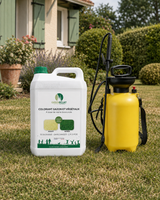
To apply the concentrates, the empty reusable 750 mL sprayer is for touch-ups and small areas; for a lawn, a pressure garden sprayer saves effort, such as our 2 L pressure sprayer, offered subject to availability.
Which shade of green to choose
People looking for green grass paint often hesitate over the shade. Greeneclat offers two, at the same price, and they can be mixed.
- Meadow Green, light and fresh: the default choice for a lawn that is still green or slightly yellowed, young turf, a golf course, boxwood. It suits gardens in north-western France well. All Meadow Green formats.
- Forest Green, deep and matt, more corrective: very yellow or burnt turf, shaded areas, the dry south of France, sports grounds, thujas, cypresses and conifers. All Forest Green formats.
The guide which shade to choose and the article Meadow Green or Forest Green help you decide. The simplest is still to send us a photo of your lawn: we will advise you on the shade and dosage.
What the colorant does not do
It is better to know before you buy. Greeneclat recolours the living parts of grass or a hedge, and only that.
- It does not make grass grow back and replaces neither seeding nor turfing: a dead area is reseeded.
- It treats no disease, box tree moth included.
- It is not a fertiliser, a weedkiller, a biostimulant or a plant protection product.
- It does not prevent new urine spots from appearing.
- Its colour goes with the mowing: on a lawn, go over it again after 2 to 3 months if needed.
Why Greeneclat
Greeneclat is a family business from Maisons-Laffitte, founded by two brothers and their father, born in 2023 out of a summer of drought. The colorant is made in France and packed in France at a sheltered work centre (ESAT) by workers with disabilities.
- Innovation Award given by independent garden centres at the JDC 2026.
- A France Télévisions report on the innovative products at the JDC.
- A water-based formula: organic pigments, a 98% bio-based plant resin, water.
- Recolouring rather than overwatering for appearance: more ecological than excessive watering, with up to 80% less water on treated areas (internal study).
You have a 14-day withdrawal period and the 2-year legal guarantee. A sample is available on request.
Frequently asked questions
Is it grass paint?
No. Greeneclat is a colorant: the blades stay alive and keep growing, with no plastic film. People often find it by searching for "grass paint" because the two look alike in use, but the colour fades gradually with mowing, over 2 to 3 months on a lawn.
How long does the colour last?
On a lawn, 2 to 3 months: the shade goes with the blades cut at each mowing. On hedges, thujas, cypresses and boxwood, which are not mown, it lasts 6 to 12 months. The details depending on rain, mowing and watering are in our article painted grass: how long does the colour last.
What happens if it rains after application?
Allow 8 hours without rain after application. After that, the colour is set. If a shower falls earlier, judge the result once the grass is dry and, if needed, make a light pass.
Can my dog and children go on the lawn?
Yes, once the product is dry: under 2 hours in usual conditions, 2 to 3 hours in summer. Keep them away during application and drying. The product carries no pictogram and no CLP classification element.
Can a recoloured lawn be mown?
Yes, as usual, once dry. The grass keeps growing normally. Each mowing removes the coloured part of the blades, which explains why it lasts 2 to 3 months on a lawn.
How much product do I need for my lawn?
Allow 400 m² per litre of concentrate on a healthy lawn and 200 m² on a badly burnt lawn. For 300 m² of healthy lawn, one 1 L concentrate is enough. For a few spots, the 750 mL spray covers about 10 m².
Can dead grass be recoloured?
No. The colour binds to a living blade. An area where the grass is dead, or bare soil, is reseeded or overseeded. You can, however, recolour very yellow or dormant grass, which is alive even if it does not look it.
Further reading
Our practical guides, by topic:
- Understanding: before you buy · paint or colorant · how long the colour lasts · cost per m²
- Lawns: yellow lawn · burnt lawn · urine spots · winter dormancy · watering restrictions
- Hedges and equipment: thuja turning brown · yellowing boxwood · working out the quantity · choosing a sprayer
- Uses: selling your house · weddings and receptions · golf · sports pitches
A question about your lawn? Send us a photo through the contact page or WhatsApp: we will reply with the right shade, format and dilution. Are you a landscaper, golf course or local authority: Request a trade price. All the other answers are in our FAQ.
Updated on 4 November 2026 by Pierre Joutel, managing director of Greeneclat.