Shared residential green spaces and drought: what a co-ownership should decide

Under water restrictions, a residential co-ownership keeps its green spaces presentable by sorting its lawns: let those that will turn green again with the rain go yellow, reseed dead areas in autumn, and recolour only the lawns everyone sees, such as the entrance to the development. The managing agent and the landscaper under contract organise these choices, within the budget voted at the general meeting.
In summer, the residents' council often receives the same comments: the entrance lawn has turned yellow, the automatic watering has stopped, or on the contrary runs in the middle of the day, and the garden no longer looks like the photos in the sales listings. The managing agent has to enforce the drought order and keep to the budget. This article takes the subject in order, from the watering rule to the choice of lawns to treat.
What restrictions impose on a residential development
In France, water restrictions follow four levels of severity: vigilance, alert, heightened alert and crisis. The national implementation guide sets minimum measures for each use, which each department's framework order adopts and can tighten. For watering lawns, flower beds and green spaces, they apply to all users.
In practice, for a development with automatic watering:
- at vigilance: no restriction, only calls to save water;
- at alert: watering lawns is banned from 11 am to 6 pm, so the cycles have to be reprogrammed outside this window;
- at heightened alert and crisis: watering lawns is banned. Only trees and shrubs planted in open ground less than 2 years ago may still be watered, from 8 pm to 9 am.
To find out the rules that apply to your address, VigiEau asks for the consumer profile, the type of water used (mains, well or borehole, watercourse) and the address of the development. A useful point: the minimum measures do not apply to harvested rainwater. Unless the local order provides otherwise, a tank can therefore be used to water young plantings. Our article on watering restrictions and the garden explains how to read an order.
Four options for the development's lawns
Let the secondary lawns turn yellow
A well-established lawn that turns brown in summer is generally not dead. The Royal Horticultural Society (RHS) explains that its roots stay alive and send up leaves when the rain returns, and advises not watering established turf, however brown it is. For lawns at the back of the plot, banks and strips that are barely visible, this is the most frugal option. A notice in the entrance halls ("lawns dormant, they will turn green again with the rain") heads off some of the comments.
Adapt maintenance during the drought
The RHS advises mowing less often and higher in dry weather, leaving the clippings in place to retain moisture, and stopping mowing when the grass is no longer growing. These instructions fall under the maintenance contract: the residents' council can ask the landscaper to apply them during dry spells.
Reseed what has died in autumn
The autumn after a dry summer is the right time to reseed thin areas, preferably with a drought-tolerant mix, richer in fescues. This work also helps the lawn cope better with the following summer.
Recolour the showcase lawns
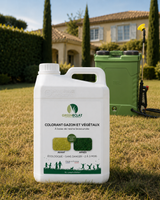
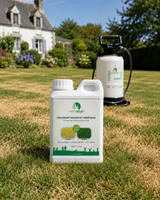
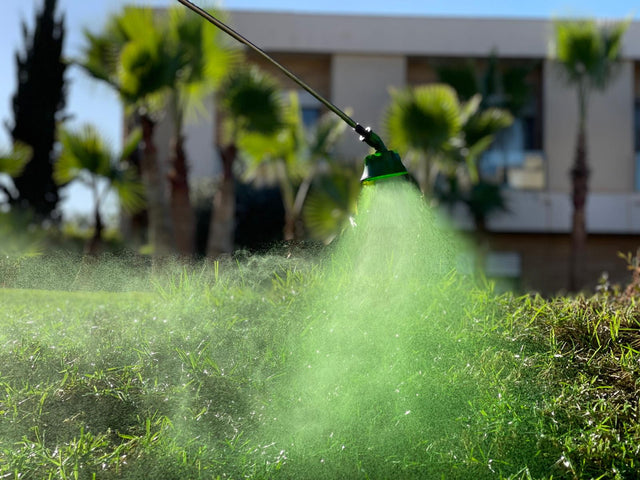
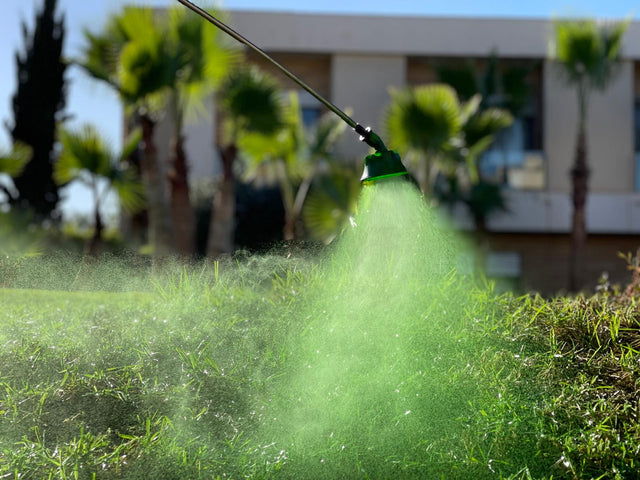
That leaves the areas everyone sees: the entrance to the development, the areas around the entrance halls, the garden facing the street or under the windows. On these lawns, yellowed but still present, recolouring brings back the green in one visit. What is commonly called grass paint is here a colorant: Greeneclat is made of organic pigments, a 98% bio-based plant resin and water, and the blades stay alive and keep growing, with no plastic film.
Who decides, and on what budget
In a French co-ownership (copropriété), land set aside for everyone's use, such as gardens and parks, is part of the common areas. The co-ownership regulations specify which areas and how charges are shared. The managing agent (syndic), the executive body of the co-ownership, administers the building and must maintain the common areas.
The provisional budget, prepared by the managing agent in consultation with the residents' council, groups the running costs, including maintenance contracts. The general meeting votes on it every year, by simple majority. The corresponding charges are then shared among the co-owners according to their share.
In practice, recolouring can take two routes: an option requested from the landscaper already under contract, or a line planned in the following season's budget and presented to the general meeting. The managing agent will tell you which route suits your contract and the amount involved. To prepare the discussion, the residents' council can ask the landscaper for a costing area by area, distinguishing what is left to yellow, what is reseeded and what is recoloured.
What quantities for a residential development
Greeneclat concentrate covers up to 400 m² per litre on a healthy lawn, and 200 m² per litre on a badly scorched lawn. The 5 L Pro container therefore covers 1,000 to 2,000 m². Our calculator gives:
| Development and area to recolour | Healthy lawn (400 m² per litre) | Badly scorched lawn (200 m² per litre) |
|---|---|---|
| Small development, 800 m² of visible lawns | 1 container of 5 L Pro | 1 container of 5 L Pro |
| Large development, 2,500 m² of visible lawns | 2 containers of 5 L Pro | 3 containers of 5 L Pro |
For the professional who applies it, the material cost in concentrate is around €0.10 to €0.15 per m², to which the labour for the service is added. This is an order of magnitude: terms depend on volumes. The final price for the co-ownership is the one in the landscaper's quote.
Organising the application day
- Notify residents with a notice a few days beforehand: date, areas, drying time.
- Have the lawns mown before application, for an even result.
- Check the weather: you need 8 h without rain after application, and the automatic watering must stay off during that slot.
- Dilute according to the state of the lawn: 1:30 badly scorched or dormant, 1:40 moderately damaged, 1:50 still green.
- Mark off the areas: children and pets stay away during application and drying, under 2 h in usual conditions, 2 to 3 h in summer. Once dry, the product is safe for them.
For the shade, Meadow Green, light, suits lawns that are still green and the north-west quarter of France. Forest Green, deeper and more corrective, suits very yellow lawns, lawns in the shade of buildings, the dry regions of the South and thuja hedges. The guide which shade to choose for your lawn compares the two. On a lawn, the colour lasts 2 to 3 months and goes with the mowing; on hedges, 6 to 12 months.
Labbé law, safety, water
According to Service-Public, since 1 July 2022 the ban on using plant protection products under France's Labbé law has extended to private residential properties, including their outdoor and amenity areas. Greeneclat is not a plant protection product: it recolours without treating, and does not replace any method of maintaining or protecting plants.
- Regulatory: no pictogram, no CLP classification element, a safety data sheet free of any hazard, available on request.
- Water: up to 80% less water on the treated areas (internal study). Recolouring a lawn for its appearance is more ecological than excessive watering.
- Origin: made in France, packed in France at a sheltered work centre (ESAT) by workers with disabilities.
The limits to state at the general meeting
The colorant recolours the grass that is there. It does not make grass grow back, does not fill in a bare area and treats no disease. It is applied neither to soil, nor to mulch, nor to moss, nor to flower beds or a shared vegetable garden. Artificial grass is not a validated use. Stating these limits from the outset prevents a co-owner from expecting recolouring to do what it does not do.
Frequently asked questions
Can the lawns be recoloured when watering is banned?
Restriction measures govern uses of water, such as watering lawns. Recolouring is done in a single application, with no watering afterwards. Always check the order in force on VigiEau before going ahead.
Should residents be notified before application?
It is strongly advised. A notice in the entrance halls a few days beforehand gives the date, the areas treated and the drying time. During application and drying, under 2 h in usual conditions, children and pets stay away. Once dry, the product is safe for them.
How long does the colour last on the development's lawns?
Two to three months on a lawn: the colour gradually goes with the mowing, so faster if the contract provides for frequent mowing. On thuja, cypress or laurel hedges, it lasts 6 to 12 months.
What should be done with areas where the grass has died?
Reseed them in autumn. Where the grass has disappeared, the soil remains visible and a colorant changes nothing. The Royal Horticultural Society recommends reseeding thin areas in the autumn after a dry summer, with a drought-tolerant mix. The development's landscaper can cost it separately.
Request a trade price
Managing agent, residents' council or the development's landscaper: professional terms are not published, they depend on volumes and sizes. The size suited to residential developments is the 5 L Pro Forest Green concentrate, also available in Meadow Green. The landscaper will find the service described in detail on our page about professional lawn colorant. To receive the terms, go to the Request a trade price page, with a photo of the lawns concerned and their approximate size.