Lawn paint: is it dangerous for children, dogs or the grass itself?

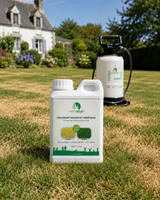
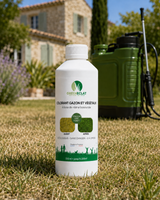
Whether lawn paint is dangerous depends on the product, and its label tells you. Greeneclat, a colorant made of organic pigments, a 98% bio-based plant resin and water, is safe for children and pets once dry, which takes under 2 hours in usual conditions. During application and drying, keep them away.
The question comes up every time recolouring a lawn is mentioned, and it is a fair one: we are talking about a product sprayed where children play and the dog rolls around. Here is what you need to know, for Greeneclat and to judge any other product.
The time to watch: application and drying
While the product is liquid, it settles on whatever touches it: paws, hands, clothes, toys. This is the phase when everyone is kept at a distance. Once dry, it is safe for children and pets.
- Drying takes under 2 hours in usual conditions, 2 to 3 hours in summer.
- In high, constant humidity, especially by the sea with repeated dew, full setting can take several days: wait until the grass is dry to the touch before reopening the garden.
- After application, it needs 8 hours without rain for the colour to set properly.
In practice, treat the lawn while the children are at school and the dog is out for a walk, then reopen it a few hours later.
What the label says, and how to read another product's label
In the European Union, the CLP Regulation (EC) No 1272/2008 requires manufacturers to classify their mixtures and to label hazardous ones, with pictograms and hazard statements, before selling them. The label is therefore the first place to look, whatever product you are considering.
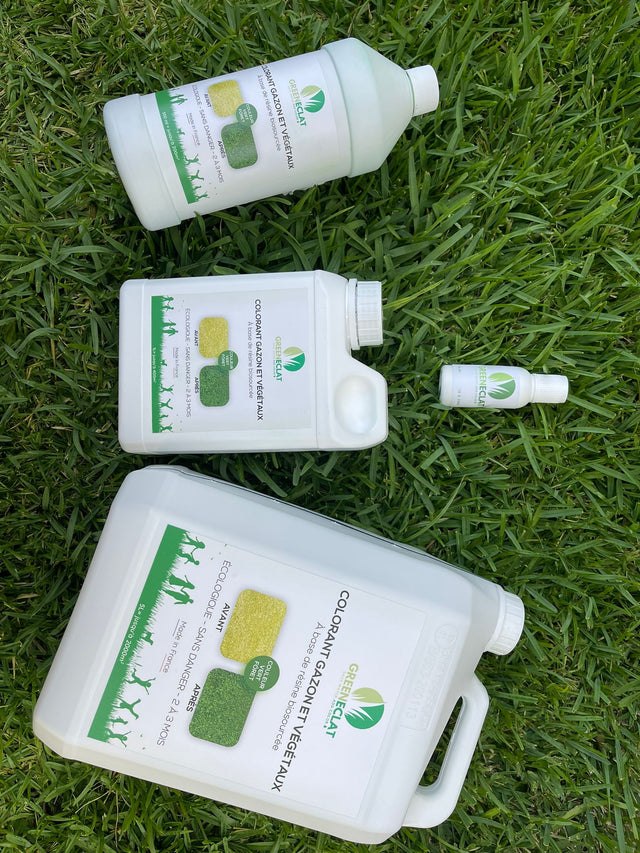
For Greeneclat: no pictogram, no CLP classification element, a safety data sheet free of any hazard, available on request. Our composition and safety page sets out these points in full.
Be wary, on the other hand, of a product not designed for turf. Spray paint or masonry paint is formulated for an inert surface, and its label reflects that use, not a lawn where children play. We explain this difference in the article lawn paint or lawn colorant: the difference.
Children
Once the lawn is dry, they can play, sit and picnic on it as usual. Before then, keep them indoors or in another part of the garden. Store the concentrate out of their reach, like any garden product, and do not leave a filled sprayer lying around.
The colorant is not applied to vegetable patches, edible plants or flowering plants. If your children pick strawberries or tomatoes at the edge of the lawn, cover those plants with a tarpaulin during treatment.
Dogs and cats
Same rule: kept away during application and drying, free to come back afterwards. The most common case is a dog that walks across wet grass and then licks its paws. If that happens, rinse its paws with clean water. If it has drunk undiluted product or knocked over the container, call your vet with the packaging to hand.
Many dog owners write to us about the yellow spots left by urine. The 750 mL ready-to-use sprayer recolours more than 100 spots, but it does not stop new ones from appearing. To deal with the cause, read the article yellow dog urine spots on the lawn: what to do.
The effect on the grass
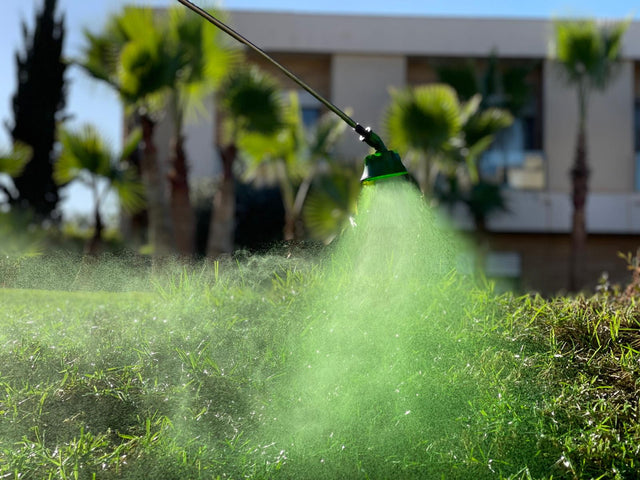
A colorant applied correctly leaves the blade alive: the grass keeps growing, and the coloured part goes with the mowing over two to three months. With Greeneclat, the resin binds the pigments without forming a plastic film.
Any deposit on a leaf does, however, hold back some of the light. A Texas A&M team measured this on transparent plates treated at label rates: the long-lasting colorants tested held back 20 to 40% of the light useful for photosynthesis, the short-lasting products 10% or less. The researchers advise caution with repeated applications or in low light. We draw three instructions from this:
- use the dilution suited to the state of the lawn (1:30, 1:40 or 1:50);
- make two light passes rather than one heavy pass;
- do not stack layers on a shaded lawn.
Nor does the colorant heal the grass. A lawn yellowed by drought generally has living roots and greens up again with rain, according to the Royal Horticultural Society: recolouring changes how it looks in the meantime, without speeding up that recovery.
The right steps, in order
- Choose a product designed for turf and read its label.
- Wear gloves and old clothes for spraying.
- Protect the vegetable patch, flowers, paving and furniture.
- Keep children and pets away until it is completely dry.
- Store the concentrate out of reach and rinse the sprayer with clean water.
The detailed step-by-step is in our guide to recolouring your lawn.
What the product does not do
Greeneclat recolours existing living parts. It does not make grass grow back, does not feed the lawn and treats no disease: it is not a fertiliser, a weedkiller, a biostimulant or a plant protection product. As for water, recolouring rather than overwatering is more ecological than excessive watering: up to 80% less water on treated areas (internal study).
Frequently asked questions
How long should I keep the dog off the lawn?
Until the product is dry: under 2 hours in usual conditions, 2 to 3 hours in summer. In very humid weather or by the sea, wait until the grass is dry to the touch. The simplest is to treat the lawn while the dog is out for a walk or indoors for half a day.
My child touched the grass while it was still wet. What should I do?
Wash their hands with soap and water, and change their clothes if they are stained, washing them separately. Then keep them away from the area until it is dry. If in doubt, or if the product has been swallowed, call your doctor or a poison control centre with the container to hand.
Does the colorant damage the grass?
Applied at the right dilution, it leaves the blade alive: the grass keeps growing and the colour goes with the mowing. Any deposit holds back part of the light, hence three precautions: the dilution suited to the state of the lawn, two light passes rather than one heavy one, and no stacked layers on a shaded lawn.
Can I treat a lawn next to a vegetable patch?
Yes, provided you protect the vegetable patch. The colorant is not applied to edible or flowering plants: cover them with a tarpaulin, choose a windless day and spray close to the ground along the edge, or leave an untreated strip.
For a few spots or a small area
The 750 mL Meadow Green ready-to-use sprayer covers about 10 m², or more than 100 urine spots, with no dilution or equipment, at €32.99. For a whole lawn, our page grass paint: the complete guide points you to the right format. A question about your situation? Write to us or send a photo.