Lawn paint or lawn colorant: what is the difference for your grass?
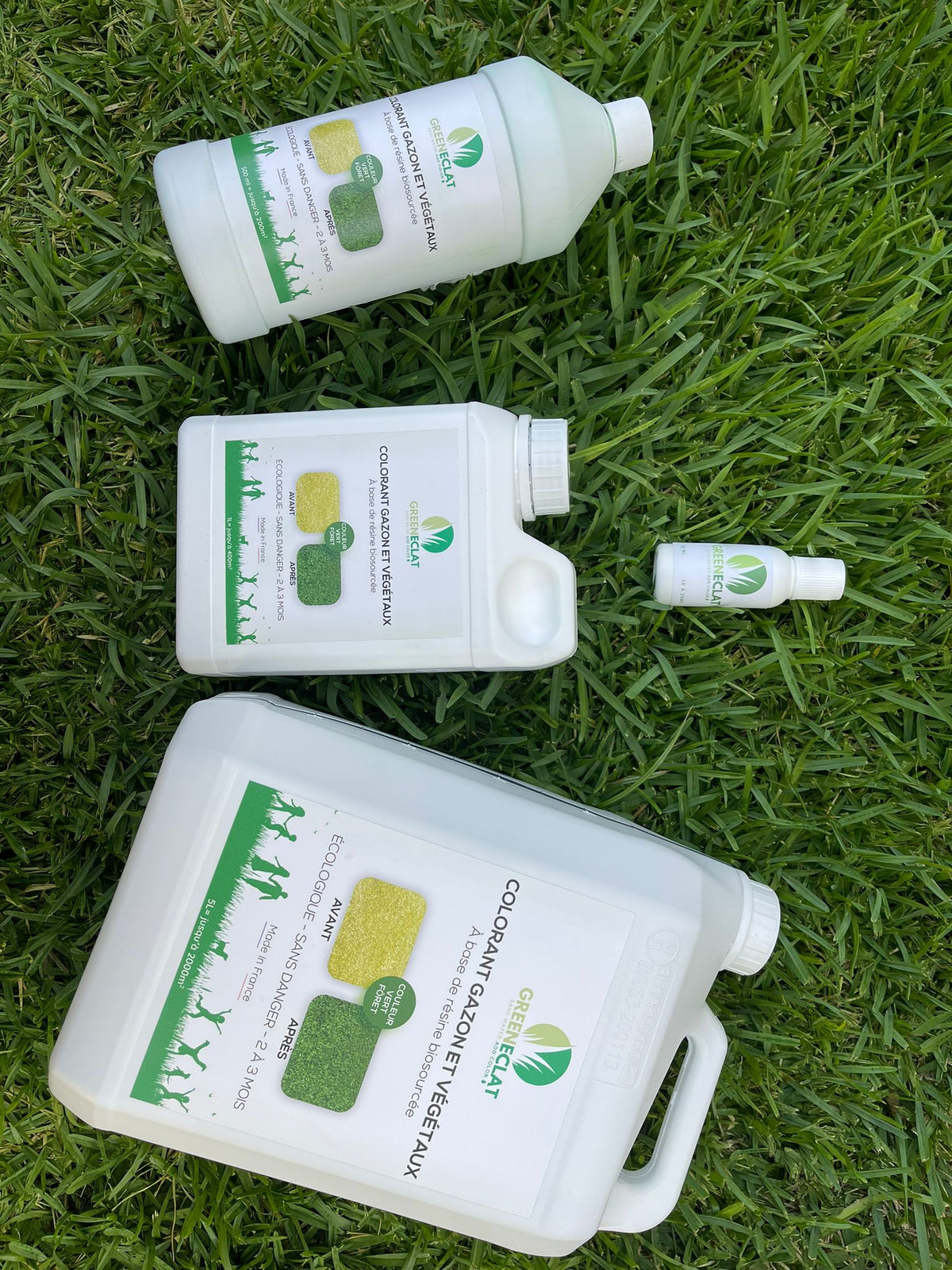
Lawn paint or lawn colorant: on the shelf, the two words often describe the same type of product. The technical difference lies in the binder. A paint in the strict sense forms a solid, opaque layer. A lawn colorant binds pigments to the blade with little binder: the grass stays alive, keeps growing and the colour goes with the mowing.
What the two words cover
Researchers at North Carolina State University, who evaluated more than thirty turf products, give simple definitions. A paint has four components: a solvent, pigments, a binder and additives. Applied as a thin layer, it turns into an opaque solid. The binder, often a resin, makes up 10 to 40% of the concentrate in this type of product. At the other end are pigments with almost no binder, which generally last only one to two weeks. In between, the trade talks about colorants.
A Texas A&M team makes the same distinction: paints contain far more pigment and are used, for example, in stadium end zones, while the colorants used on golf courses contain much less pigment, and less binder too.
In shops, these nuances disappear. Many products sold as grass paint are actually colorants, and the word paint is used mainly because it is the one buyers type. To compare, look at the composition rather than the name. Our reference page on grass paint covers the topic as a whole.
On the blade: a covering layer or a colorant
A covering paint lays a film on the surface that hides what is underneath. On a wall, that is the point. On a living leaf, it raises a question: light must still reach it. The Texas A&M team measured the light useful for photosynthesis passing through transparent plates treated at label rates. The long-lasting colorants tested held back 20 to 40%, the short-lasting products 10% or less. The authors advise caution with repeated applications or in low light.
In practice, this gives three common-sense rules: stick to the intended dilution, prefer two light passes to one heavy pass, and do not stack layers on a shaded lawn.
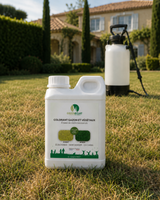
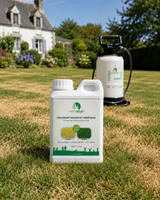
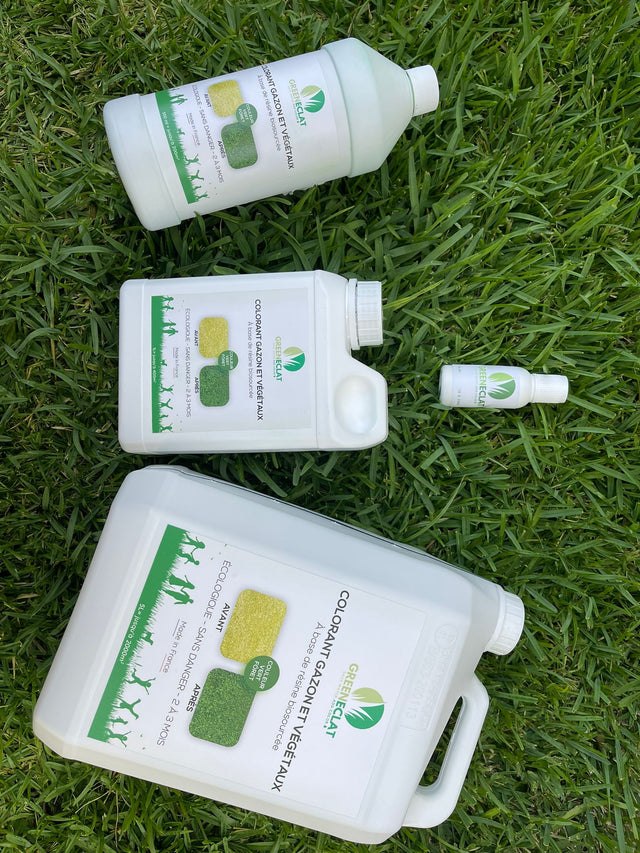
Greeneclat is made of organic pigments, a 98% bio-based plant resin and water. The resin binds the pigments to the leaf without forming a plastic film. The blade stays alive and keeps growing.
At mowing time: the colour goes with the clippings
This is the simplest test to know what you applied. On turf treated with a colorant, each mowing removes the coloured part of the blades, and the colour fades gradually as the grass grows. With Greeneclat, it lasts two to three months on a lawn. On a hedge, a thuja or a boxwood, which are trimmed far less often, it stays six to twelve months.
This gradual fading is intended. It means that nothing stays stuck to the lawn from one season to the next, and that the regrowth takes over with its own colour.
Safety: the difference is on the label
A product's name says nothing about its safety. The label does. In the European Union, the CLP Regulation (EC) No 1272/2008 requires hazardous mixtures to be classified and labelled, with pictograms and hazard statements. A product that carries them must be handled accordingly.
For Greeneclat: no pictogram, no CLP classification element, a safety data sheet free of any hazard, available on request. The product is safe for children and pets once dry. During application and drying, keep them away. Drying takes under 2 hours in usual conditions (2 to 3 hours in summer). We detail these precautions in the article lawn paint: is it dangerous for children and dogs. Ingredients and safety rules are set out on our page Greeneclat lawn colorant: composition and safety.
How to know what you are buying
| What to check | What it tells you |
|---|---|
| The stated use | Recolouring turf, marking lines or an inert surface: three different products |
| The type of binder | What stays on the blade and how the colour goes |
| Dilution and coverage per m² | A very diluted product covers more ground, a more loaded product hides more of the yellow |
| The pictograms | Whether or not there is a hazard classification |
| The stated duration | One to two weeks for pigments alone, several weeks to a few months for a colorant with a binder |
| The shade | A green that is too blue or too bright shows more than a matt green |
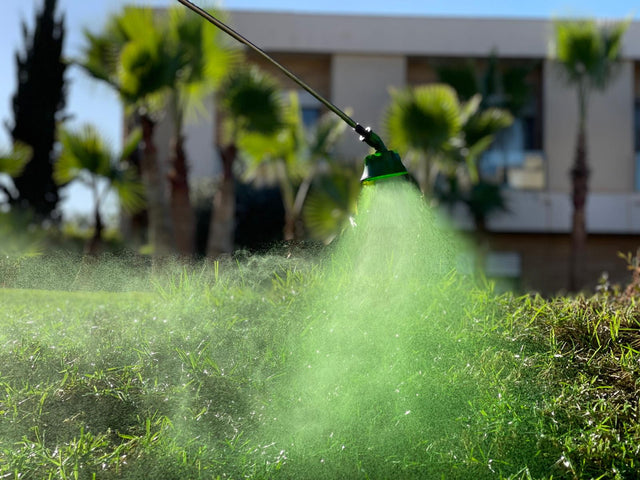
For the use we are dealing with here, a yellowed garden lawn, look for a colorant designed for living turf, diluted according to the state of the grass. Ours are diluted at 1:30 for badly burnt, bleached or dormant turf, at 1:40 for moderately damaged turf and at 1:50 for turf that is still green. The guide grass paint: what to check before you buy covers the other criteria.
What neither one does
Whether you call it paint or colorant, this type of product changes how grass looks and nothing else. It does not make grass grow back and does not replace seeding. It does not feed the lawn: it is not a fertiliser, a biostimulant, a weedkiller or a plant protection product. It treats no disease. On bare soil, moss or dead plants, there is nothing to recolour.
Frequently asked questions
Can painted grass still grow?
With a colorant applied at the right dilution, yes: the blade stays alive and keeps growing, and the coloured part goes with the mowing. Researchers do, however, advise against repeated, heavily loaded layers, especially in shade, because a thick deposit holds back part of the light.
Is Greeneclat a paint?
No. Greeneclat is a colorant made of organic pigments, a 98% bio-based plant resin and water. The blades stay alive, with no plastic film. We use the word paint in this article because it is the one people search for.
Can I use spray paint or masonry paint on a lawn?
We advise against it. Building paint is formulated to cover an inert surface with an opaque layer, not a plant that grows and is mown every week. Use a product designed for turf, whose label states this use.
Are line-marking products for sports pitches suitable for recolouring a lawn?
They are used to mark visible lines, often in white, and are not designed to give an even green shade to a whole lawn. To recolour yellowed turf, choose a colorant designed for this use, in a shade close to that of your grass.
Recolour with the right shade
For very yellow, burnt or shaded turf, or for thujas and conifers, the 1 L Forest Green concentrate gives a deep, matt green, over 400 m² of healthy lawn or 200 m² of badly burnt lawn, at €89.99 with free delivery from the 1 L (France). For a lawn that is still green, Meadow Green is a better fit: compare the two in the guide which shade to choose, or send us a photo for advice on shade and dilution.