Yellow lawn: the causes, the right diagnosis and the fixes
A yellow lawn is most often short of water: in dry weather, grass goes dormant, its roots stay alive and it greens up again when the rain returns. The other common causes are dog urine, too much fertiliser, mowing too short, grubs or disease. Find the cause, then wait, reseed or recolour.
Read the pattern of the yellowing before acting
The Royal Horticultural Society (RHS), the UK's leading horticultural charity, makes the point: it is hard to diagnose a yellow patch from its appearance alone. It is more useful to ask which causes could apply to your garden, the season and what you did on the lawn in the previous days. This table sets out the situations described by the RHS and by the University of Maryland Extension.
| What you see | Likely cause | First step |
|---|---|---|
| Large yellow or straw-coloured areas in summer, especially on sandy soil or over tree roots | Lack of water in the soil | Raise the mowing height and wait for rain |
| Yellow circles ringed with dark green, where the dog goes | Dog urine | Water the spot straight away |
| Regular stripes or patches that appeared after a fertiliser application | Fertiliser overdose | Pick up the excess and flush the soil with water |
| Patches on bumps, just after mowing | Grass cut too short | Raise the blade, level the bumps |
| Irregular patches where the mower was refuelled | Spilt petrol or oil | Repair the area, refuel off the lawn |
| Patches that spread fast, birds pecking at the turf | Grubs eating the roots (leatherjackets, chafer grubs) | Identify the grubs before any treatment |
| Yellow then brown patches in damp weather, from autumn to spring | Fungal disease (fusarium patch, red thread, rust) | Aerate, improve drainage, avoid excess nitrogen |
| Brown patches on a new lawn | Buried rubble or soil compacted by machinery | Remove it, decompact, reseed |
Drought, the leading cause of a yellow lawn in summer
In a hot, dry summer, a lawn can turn completely brown and stop growing. According to the RHS, on a well-established lawn the roots stay alive and send up new leaves as soon as the rain returns. Very fine lawns (bentgrass) suffer more than family lawns rich in fescues, which tolerate dry conditions better.
The useful steps are modest: mow less often and higher, leave clippings on the lawn to keep moisture in the soil, and stop mowing if the grass is no longer growing. The RHS advises against watering an established lawn, even a very yellow one: it recovers on its own. Only lawns sown or turfed in spring need water during their first summer. If the summer has been harsh, the following autumn is the time to overseed areas that have stayed thin.
The details, with the signs that tell dormant grass from lost grass, are in our article drought-burnt lawn: bring it back or recolour it.
The other causes and how to deal with them
Dog urine
Urine deposits a lot of nitrogen, salts and lactic acid on a small area. The centre yellows, the edge turns greener because of the nitrogen. The University of Maryland notes that watering the spot quickly dilutes the urine and limits the damage, and that damage is worse on turf already stressed by heat. We devote a full article to it: yellow dog urine spots on the lawn.
Too much fertiliser or weedkiller
Fertilisers are mineral salts. In excess, they stop the roots from taking up water, and the symptoms look like drought. Fertiliser burn often comes from a badly set spreader, overlapping passes or a spilt bag. The same logic applies to an overdosed weedkiller or moss killer, which can also leave footprints. See fertiliser burn on the lawn: what to do.
Mowing too short and fuel
Cutting too short weakens the grass, especially on bumps where the blade scalps. The RHS recommends raising the cutting height and levelling out irregularities. Petrol or oil spilt while refuelling on the lawn kills the grass in patches: refuel on a path. If the patch is where a trampoline, tarp or pool has been standing, our article on yellow grass under a trampoline, tarp or pool explains how to get it green again.
Grubs and diseases
When patches spread fast and birds peck at the turf, grubs (leatherjackets or chafer grubs) are probably eating the roots. In damp weather, in autumn and winter, fusarium patch causes yellow patches that turn brown, especially on heavily fed lawns left a little long. Red thread appears more on turf short of nitrogen, and rust yellows the leaves in late summer. These cases need a diagnosis, and no colorant treats them.
Compacted or poorly drained soil
Repeated foot traffic or a ride-on mower compacts the soil, all the more when it is wet. The roots lack air, water drains in poorly and the grass yellows. On a new lawn, buried rubble gives the same result. You need to decompact, remove the debris and then reseed. If the lawn turns yellow just after scarifying, our article on a yellow lawn after scarifying explains whether it is normal and how long it lasts.
Wait, water, reseed or recolour: choosing for your situation
Once the cause has been identified and dealt with, you still have to decide what to do about the appearance. The four options differ in cost and time.
| Option | When it fits | What it takes |
|---|---|---|
| Wait for recovery | Dormant turf that will green up with the rain | Patience, a yellow garden for several weeks |
| Water | Young lawn, or watering allowed by the local order in your area | Water, often drinking water, for a result that is mostly visual |
| Reseed or turf | Areas where the grass is dead or the soil bare | Soil preparation, in spring or autumn, then weeks of growth |
| Recolour | Grass yellowed but present, need for an immediate green look | One application, 8 hours without rain |
If nobody is going to look at your lawn before autumn, waiting is the most frugal option. Recolouring makes sense when the look matters now: guests, a house for sale, a direct view from the patio, isolated spots on a lawn that is otherwise green.
What a colorant does on a yellow lawn
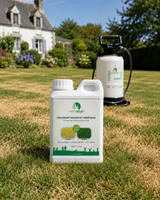
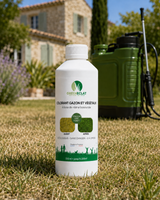
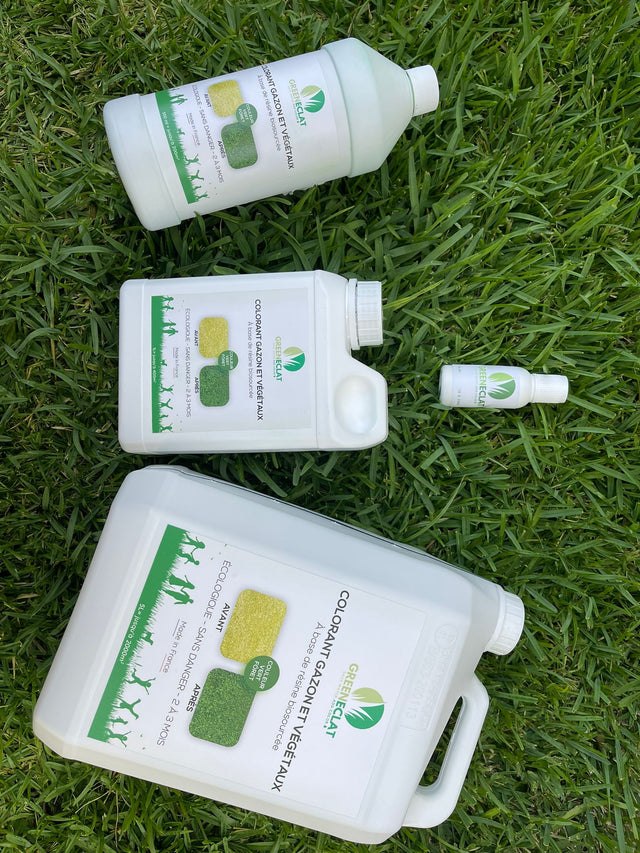
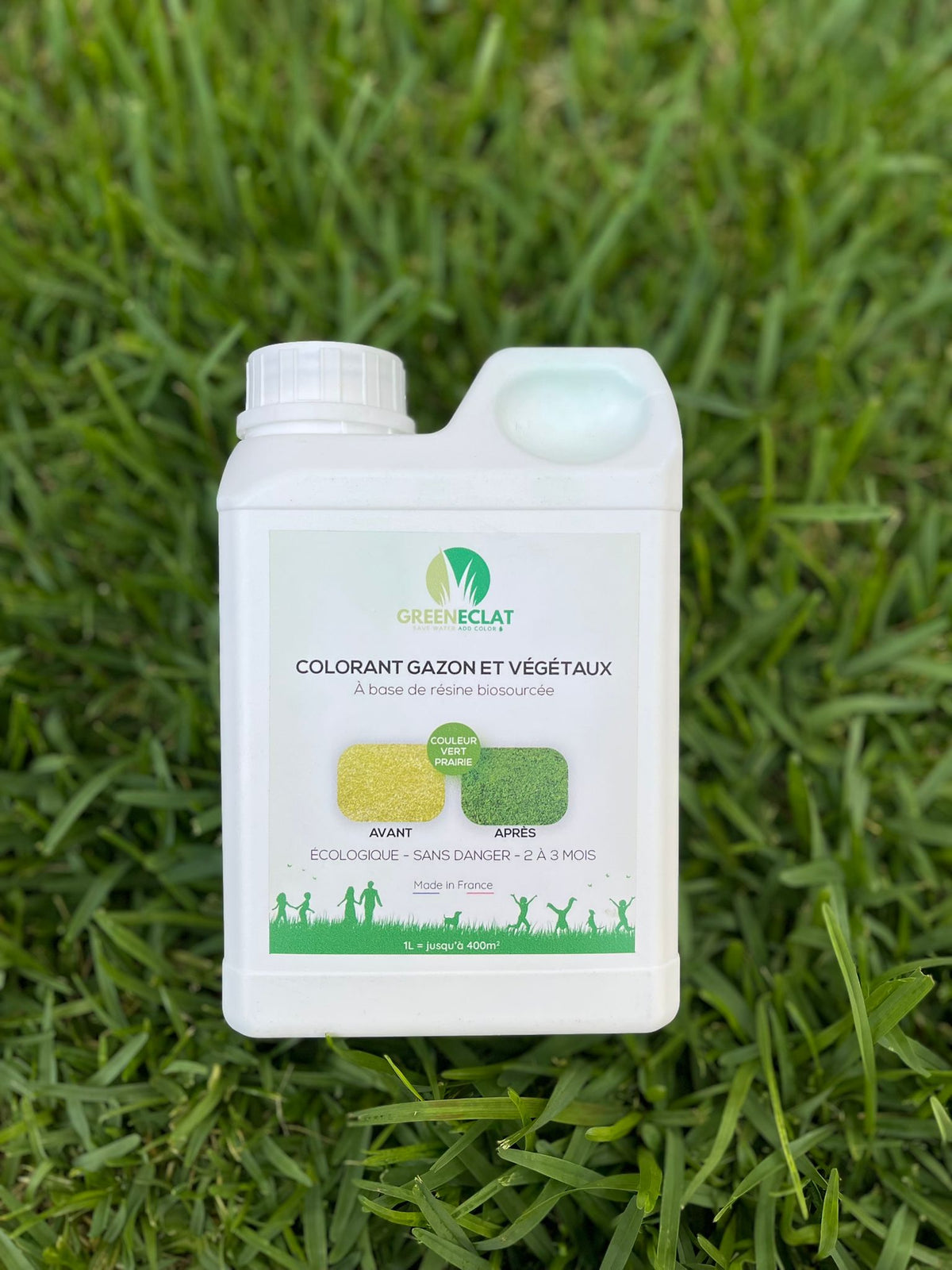
What many people call grass paint is in fact a colorant. Greeneclat is made of organic pigments, a 98% bio-based plant resin and water. It binds to the blades, which stay alive and keep growing, with no plastic film. The colour fades gradually with mowing, over 2 to 3 months on a lawn. To understand the principle before you buy, read our page grass paint: how a lawn colorant works.
There are two shades, at the same price and which can be mixed. Meadow Green, lighter, suits a lawn that is still fairly green. Forest Green, deeper and more corrective, suits very yellow or burnt turf and shaded areas. Our guide which shade to choose helps you decide, and a photo of your lawn is all we need to advise you.
As for budget, the calculation is done per m², with the price on the product page. For 400 m² of healthy lawn, one 1 L concentrate at €89.99 is enough, about €0.22/m². On badly burnt turf, coverage drops to 200 m² per litre: for 200 m², the same bottle comes to about €0.45/m².
How to use it, in brief
- Mow the lawn and remove debris for an even result.
- Shake the container, then dilute according to the condition: 1:30 for very yellow, bleached or dormant turf, 1:40 for moderately damaged turf, 1:50 for turf that is still green.
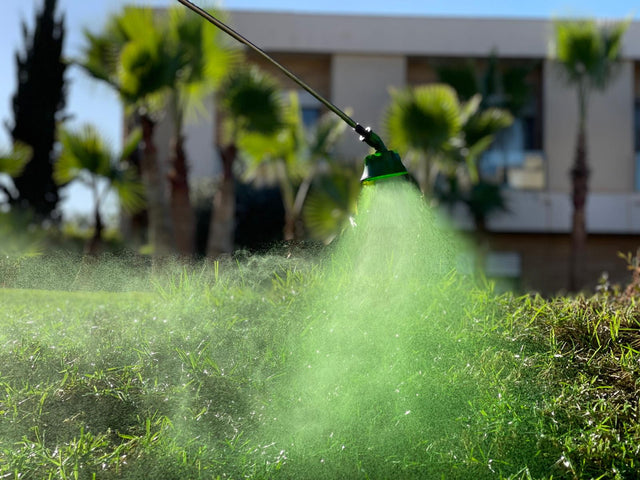
- Spray in criss-cross passes. Two light passes give a more even result than a single heavy pass.
- Allow 8 hours without rain after application. The colorant dries in under 2 hours in usual conditions, 2 to 3 hours in summer.
- Keep children and pets away during application and drying. Once dry, the product is safe for them.
The limits of a colorant
The colorant recolours existing blades, and that is all. It does not make grass grow back and does not fill in a bare area: bare soil and dead grass still need reseeding. It treats neither disease nor grubs, and it is neither a fertiliser nor a weedkiller. A new urine spot will appear over the colour. It is not applied to moss. If the cause of the yellowing is not dealt with, the yellow will come back as you mow.
Frequently asked questions
Is a yellow lawn dead?
Rarely. After a dry summer, an established lawn usually keeps living roots and greens up again when the rain returns, according to the RHS. If patches stay brown despite the rain, look for another cause (soil that has become water-repellent, grubs, disease) or reseed the area. Young lawns sown in spring are more fragile.
Should I water a yellow lawn in summer?
An established lawn generally does not need it to survive: it recovers on its own when it rains. Watering remains useful for a lawn sown or turfed during the year. In a drought, also check the order in force where you live (in France, on VigiEau), because watering lawns can be limited to certain hours or banned.
When should I reseed yellowed areas?
In spring or autumn, when the weather is cool and damp. After a dry summer, the RHS recommends autumn, with a drought-tolerant seed mix. Remove the dead grass, loosen the surface, work in a little garden soil or compost, then sow at the rate shown on the packet.
Does grass paint damage a yellow lawn?
Applied at the right dilution, no. Greeneclat is a colorant: the blades stay alive and keep growing, with no plastic film, and the colour goes with the mowing over 2 to 3 months. The product carries no pictogram and no CLP classification element, and its safety data sheet is free of any hazard, available on request.
Recolour a yellowed lawn
For a typical lawn, the 1 L Meadow Green concentrate covers up to 400 m² of healthy lawn, with free delivery from the 1 L (France) and dispatch within 48 hours. If your turf is very yellow, choose the Forest Green version. Send us a photo by WhatsApp or through the contact page: we will tell you the right shade and dilution.