Cypress turning yellow or brown: causes, fixes and what can be saved
A cypress turning yellow is often short of water, has been cut back too hard, is hosting aphids or has a canker. Start by scratching the bark of a young shoot: if it is green and moist underneath, the branch is alive and can recover or be recoloured; if it is brown and dry, it is dead and will not turn green again.
Leyland, Lawson, Italian: different cypresses
Under the same name, French gardens hold rather different trees, and they do not turn yellow for the same reasons. Leyland cypress (× Cuprocyparis leylandii) is widely used for fast-growing hedges. Lawson cypress (Chamaecyparis lawsoniana) is also used for hedging. Italian cypress, also called Mediterranean cypress (Cupressus sempervirens), grows in a column, on its own or in a row, like the Arizona cypress. On Leyland and Lawson hedges, brown patches are what you mostly see; on Italian and Arizona cypresses, you also need to think of bark canker.
The causes of a cypress turning yellow or brown
Drought, frost and wind
The Royal Horticultural Society (RHS) considers that many brown patches on conifer hedges come from difficult growing conditions: drought, frost, waterlogged soil or cold, drying winds, which prevent the trimmed foliage from renewing itself. University of Maryland Extension adds that the fungi of Leyland cypress mainly take hold on stressed trees, drought first of all. Watering at the base during dry spells, within local restrictions, and mulching to keep moisture in the soil are part of prevention.
Pruning too hard
This explains many gaps that never close. The RHS is clear: cypresses (Cupressus, Chamaecyparis and Leyland cypress) respond poorly to hard pruning, and a cut into bare wood, without leaves, will not produce new shoots. For a Leyland hedge, it advises trimming from April to the end of August, up to three times in the season, and giving the hedge an A shape, wider at the base, so that light reaches the bottom and it does not go bare. To reduce a hedge that has grown too tall, it recommends removing no more than a third of the height, preferably in early April.
Cypress aphid
This blackish-brown aphid (Cinara cupressi) feeds on the stems of Leyland, Lawson and Monterey cypresses and of thujas, mainly from April to June. Shoots turn yellow in early summer and are often brown and dry by late summer; on a trimmed hedge, the bottom is generally more affected than the top. According to the RHS, a black, powdery deposit, sooty mould, is often the only clue that confirms aphids, because the browning appears once they have already gone. A research project by the RHS and East Malling Research linked this aphid to half of the brown-patch cases studied. A damaged hedge can fill in again, but slowly.
Cypress bark canker
This disease, caused by the fungus Seiridium cardinale, affects in particular Italian cypress, Monterey cypress and Arizona cypress. The INRAE VigiJardin factsheet describes needles that turn yellow, lose their upright habit, then turn brown and dry out, first on young shoots. The most characteristic sign is resin oozing from lesions in the bark, which sinks slightly, turns red, then brown. The fungus enters through pruning cuts and bark wounds; the risk period runs from April to October. The RHS notes that on Leyland hedges, this canker is found mainly on large trees and remains rare on small hedges.
Roots and normal renewal
When a whole plant turns brown in the middle of a green hedge, the RHS suggests checking the roots: honey fungus, Phytophthora or waterlogged soil. Conversely, yellowing of the inner needles, near the trunk, can be normal: the University of Maryland points out that evergreen trees renew their oldest leaves, sometimes spectacularly after a year of strong growth or stress, without harm to the tree.
The test to do before deciding
NC State Extension describes two simple steps. Lightly scratch the bark of a young shoot with your fingernail: green, pale green or cream tissue, slightly moist, indicates a living part; brown, brittle tissue, a dead part. Work your way from the tip towards the trunk to find the boundary. Then bend a small twig: if it is alive, it bends; if it is dead, it snaps cleanly. Do the test at several heights, because a shoot can be dead at the tip and alive closer to the trunk.
What to do depending on what you see
| What you see | What helps | Worth knowing |
|---|---|---|
| Yellow inside, near the trunk | Wait | Renewal of old needles |
| Brown after a dry summer or a windy winter | Water at the base, mulch, wait for the next shoots | Brown does not turn green again |
| Gap after hard pruning | Tie in neighbouring healthy shoots to fill the space, trim more lightly afterwards | Bare wood does not regrow |
| Bottom of the hedge brown, black sooty mould | Identify the aphid, ask a professional for advice | Recovery is slow |
| Resin oozing, bark sunken and reddened | Cut the branch well below the canker, disinfect your tools | A disease that spreads |
| Foliage dull or yellowed but alive | Recolour | Immediate result, for 6 to 12 months |
For canker, the University of Maryland advises cutting affected branches several centimetres below the lesion and states that fungicides are not effective against these fungi. Since a pruning cut is a way in for the fungus, prune with clean tools and wipe the blade between trees.
Recolouring a cypress that is alive but dull
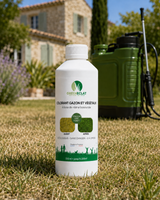
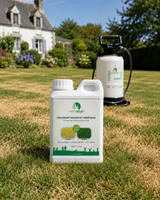
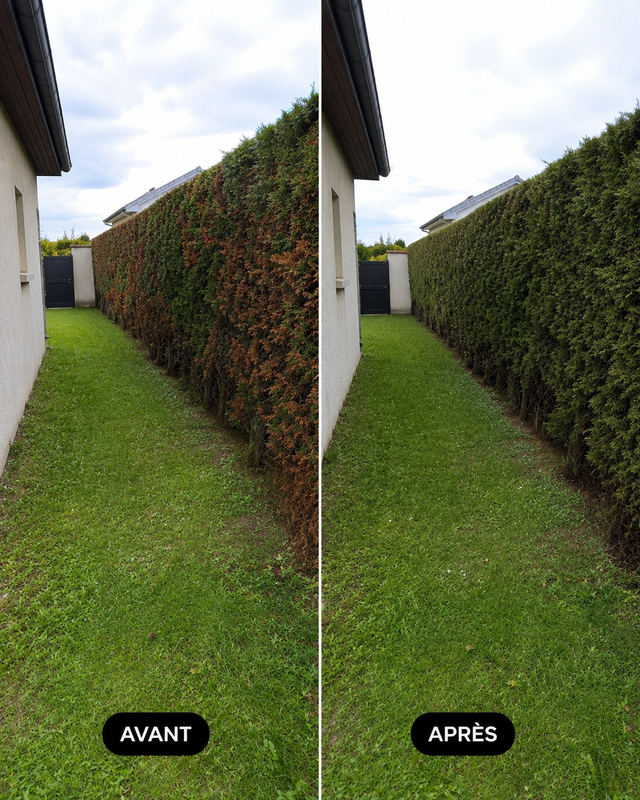
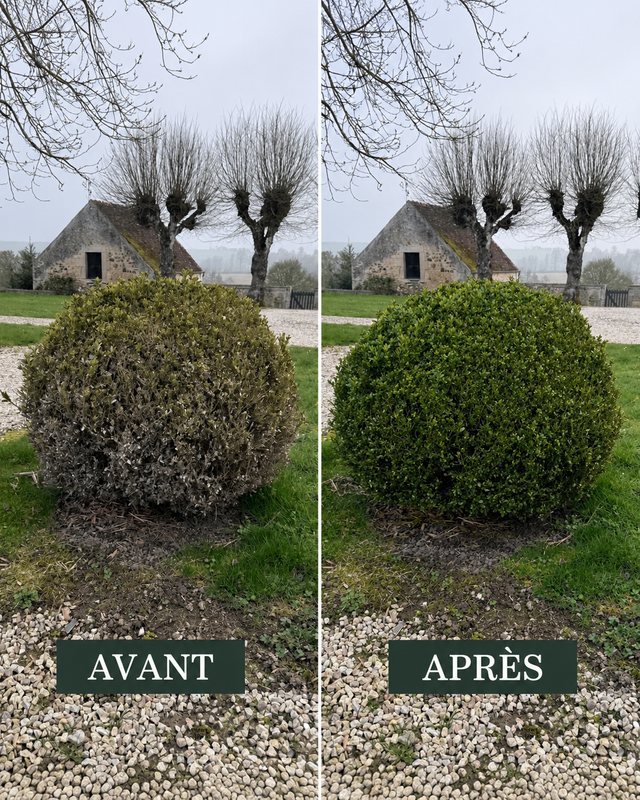
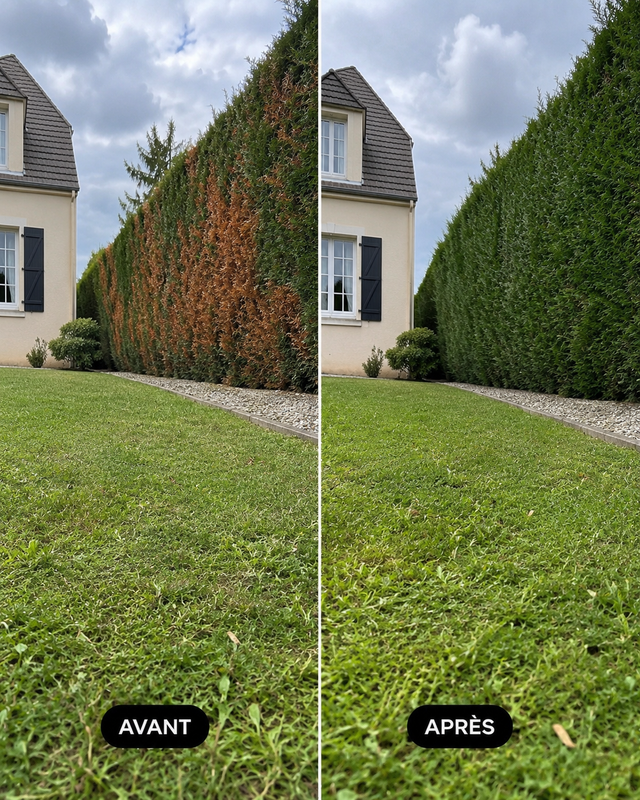
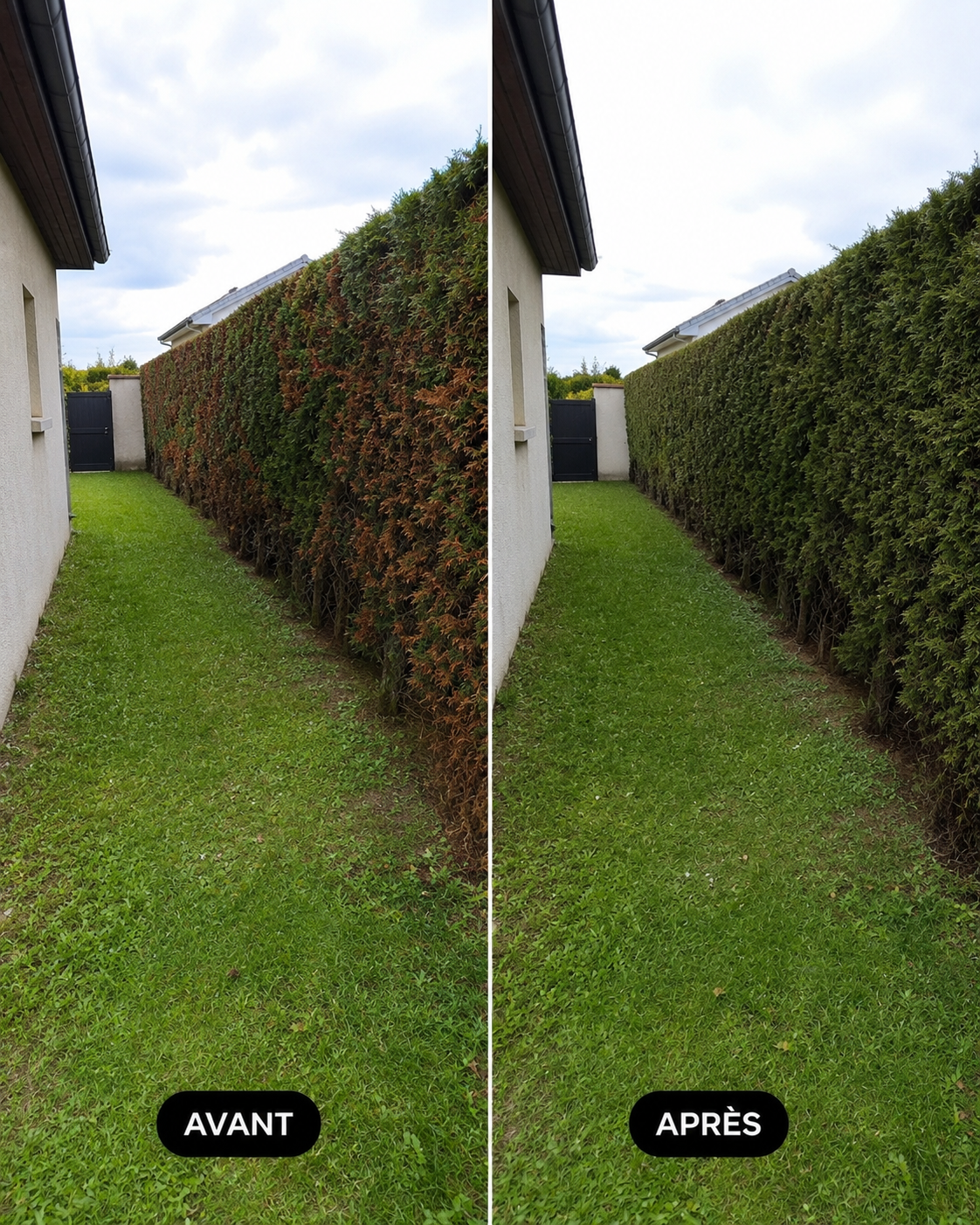
When the hedge is alive but yellowed, or while you wait for it to fill in, a colorant gives it back its green on the same day. What many people look for under the name hedge paint, like grass paint, is in fact a colorant: Greeneclat is made of organic pigments, a 98% bio-based plant resin and water, and binds to the needles with no plastic film. The foliage goes on living.
For cypresses, thujas and other conifers, the recommended shade is Forest Green, deep and matt. Dilute at 1:30 and allow 200 m² per litre of concentrate on a hedge. The colour lasts 6 to 12 months, because a hedge is not mown like a lawn. Example: one face of a Leyland hedge 20 m long and 2 m high comes to 40 m². The 500 mL Forest Green concentrate covers it; our calculation tool gives €1.75 per m² incl. VAT for these 40 m², with the €69.99 bottle bought whole, and the rest is used for touch-ups or the other face. For a complete hedge of 150 m² (both faces and the top), one 1 L concentrate at €89.99 is enough, or €0.60 per m² incl. VAT according to the same tool, with free delivery in France.
For application: first cut out the dead shoots, choose dry foliage and a windless day, with 8 h without rain ahead of you, protect walls, fences and paving, and keep children and pets away until it is dry (under 2 h in usual conditions, 2 to 3 h in summer). The full step-by-step guide, with sprayer settings, is in our guide hedge and thuja paint.
What the colorant will not do
It recolours living needles, and nothing else. A brown, dry shoot is dead: it will not turn green again, and colouring it makes no sense since it will eventually drop. Greeneclat has no effect on aphids or on canker; an affected branch stays affected, even when recoloured, which is why it is worth cutting it out first. It is not a fertiliser, does not replace the water a young cypress needs, and does not make bare wood regrow. If your cypresses are in fact thujas, our article thuja turning yellow or brown covers their specific causes.
Frequently asked questions
Can a brown cypress turn green again?
The brown needles, no. If the bark of a shoot is still green and moist when scratched, new shoots can appear on that living part, as long as it still carries green needles. If the shoot is brown and brittle all the way to the trunk, it is dead. On a cypress, bare wood does not produce new shoots.
Why is my Leyland cypress hedge turning brown from the bottom?
Two causes come up often. Cypress aphid attacks from April to June and generally affects the bottom of a trimmed hedge more than the top; black sooty mould on the stems confirms it. A hedge trimmed straight, without a wider base, also leaves the bottom in shade, and it goes bare. The RHS advises an A shape.
How do I recognise cypress canker?
According to INRAE, shoots turn yellow, then brown and dry out, the bark sinks slightly, turns red then brown, and resin oozes from the lesions. This resin flow is the most characteristic sign. It mainly affects Italian, Monterey and Arizona cypresses.
Which shade should I use to recolour cypresses?
Forest Green, deep and matt, suits cypresses, thujas and conifers. Dilute at 1:30 and allow 200 m² per litre of concentrate. If you are unsure about the result, send us a photo of the hedge by WhatsApp: we will tell you the shade and quantity.
Is your cypress hedge alive but dull? For one face of a hedge, start with the 500 mL Forest Green concentrate; for a complete hedge, the 1 L concentrate. A question about your case: write to us through the contact page with a photo.