Dead or dormant grass: the simple test to do before spending anything

To find out whether grass is dead or dormant, gently pull on a tuft. Resting grass resists and stays firm at the base; dead grass comes away without effort, with dry roots. Then open the crown, the base between leaves and roots: if it is firm, it is alive; if it is dry and thin like paper, it is dead.
Why a yellow lawn is often only dormant
When summer turns hot and dry, the grasses in our lawns stop growing and turn brown. This is dormancy, a survival mechanism. Iowa State University describes it this way: the leaves die, but the crowns and roots stay alive. Utah State University Extension explains the role of the crown: located at the soil surface, it is the point from which leaves grow upwards and roots downwards. As long as it lives, the plant can recover when temperatures fall and moisture returns.
The Royal Horticultural Society (RHS), the major British horticultural society, makes the same observation for well-established lawns: even when very brown, they keep their roots and send up leaves when the rain returns. Before buying seed, turf or a colorant, it is therefore worth checking what is happening at the foot of the grass.
The test in three steps
- Pull on a tuft. Pinch a few blades near the ground and pull gently. According to the Missouri Botanical Garden, dormant grass is firm at the base and resists. Dead grass is shrivelled, pulls out easily and comes up with dead roots.
- Open the crown. Pull up a whole plant, then separate the leaves from the crown. Kansas State University gives the criterion: if the crown is still firm, neither dry nor papery (dry and thin like paper), the plant is alive.
- Compare several spots. Do the test in full sun, in shade, at the foot of trees, on the usual path and near the edges. A lawn is rarely dead everywhere: you will know which areas to wait for and which to overseed.
The test takes a few minutes and costs only a few blades. It saves you from reseeding a lawn that was going to recover on its own, or from recolouring an area that will never turn green again.
The water test, if watering is allowed
If in doubt, water settles it. Iowa State University explains how to wake a dormant lawn: 25 to 38 mm of water in a single application, that is 25 to 38 litres per square metre, then a second identical application 7 days later. The lawn starts to green up after the second watering. You can apply this method to a square of just one metre per side, to see whether the grass recovers.
In France, first check your municipality's drought order on the VigiEau website: during restrictions, lawn watering can be limited or banned. And keep one nuance in mind: according to the RHS, a patch that stays brown after several rainfalls is not necessarily dead. The soil may have become hydrophobic, meaning it repels water, and then needs rewetting. There are other causes too, such as grubs or a disease.
How long a lawn can stay dormant
Dormancy has a limit. Iowa State University estimates that a cool-season lawn lasts 4 to 6 weeks without significant damage; Kansas State University speaks of about 5 weeks for a healthy lawn. Beyond that, the crown risks drying out, and if the crown dies, the plant dies. To improve its chances, Iowa State University advises, if possible, about 6 mm of water a week, and Kansas State University about 6 mm every two weeks: this survival watering does not bring back the green, but keeps the crown hydrated. Again, only if the drought order allows it.
Three situations call for more care:
- A lawn sown or turfed this year or last year. Its roots are less developed, and Iowa warns that it may not survive dormancy.
- A heavily trodden area. Walking on a dormant lawn damages the crowns, which may struggle to recover.
- A lawn that is yellow in winter. The causes are different (frost, standing water, fusarium patch): see our article yellow lawn in winter and dormancy.
What the result changes for you
| Test result | What it means | What you can do |
|---|---|---|
| The grass resists, the crown is firm | Dormant lawn | Wait for rain, water if it is allowed, or recolour if you want green now |
| The grass pulls out, the crown is dry | Lawn dead at this spot | Reseed or lay turf, preferably in autumn |
| Mixed results depending on the area | Partly dead lawn | Recolour the living areas, overseed the others |
For what comes next after a dry summer, our article drought-burnt lawn: recover it or recolour it sets out the timetable. Our yellow lawn guide also sums up the useful steps.
What is dead cannot be recoloured
Greeneclat recolours living blades. Dead grass, bare soil and moss are not among its surfaces. If the test concludes that the grass is dead, your budget should go on seed or turf, not on a colorant. To reseed a dead area, Iowa State University advises raking out part of the dry grass until you can see the soil, mixing one or two handfuls of seed with a little garden soil, covering the area with it, then watering regularly until germination. The area turns green in 2 to 4 weeks, and its texture gradually blends with the rest. The RHS points out that the autumn after a dry summer is the ideal time for these repairs.
If the grass is alive and you want green now
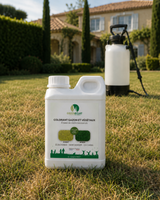
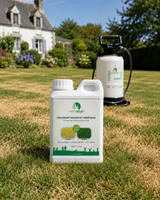
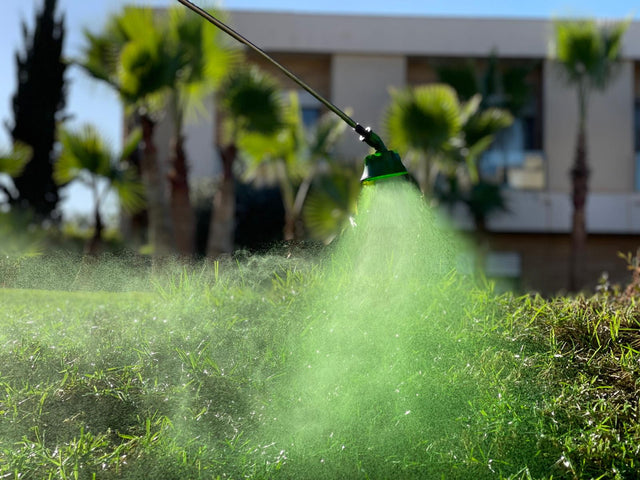
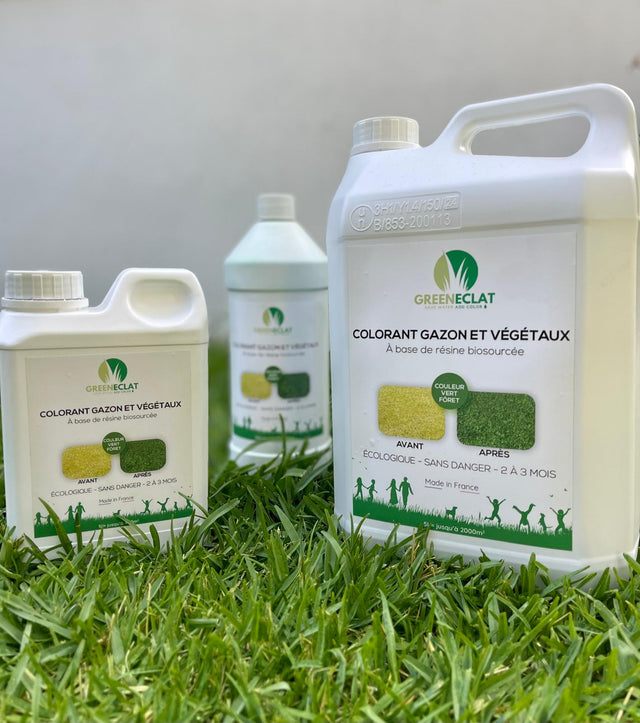
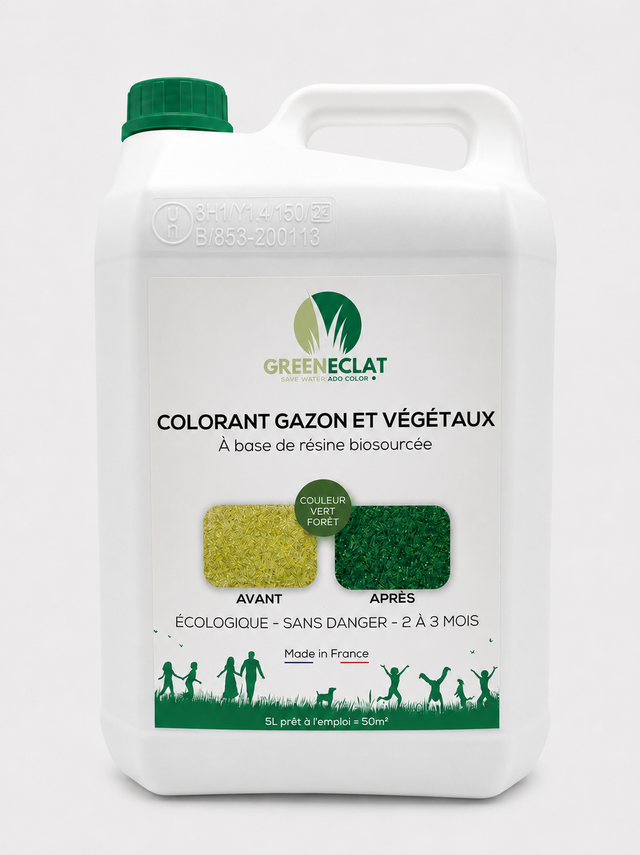
A dormant lawn can keep its yellow look for weeks. If appearance matters before it recovers, recolouring is the quick solution. What many people call grass paint is in fact a colorant: Greeneclat is made of organic pigments, a 98% bio-based plant resin and water, and binds to the blades, which stay alive, with no plastic film. When the grass starts growing again, the coloured part goes with the mowing, within 2 to 3 months.
On a dormant lawn, dilute at 1:30. The Forest Green shade, deep and more corrective, suits very yellow lawns. Allow 8 h without rain after application; drying takes under 2 h, 2 to 3 h in summer. Keep children and pets away until it is dry. On budget, on a very yellow lawn one litre of concentrate covers 200 m²: the 1 L bottle at €89.99 works out at about €0.45/m² for 200 m², and the 500 mL at €69.99 at about €0.70/m² for 100 m². If you are still hesitating between waiting, watering and recolouring, our article how to make your lawn green fast compares the timescales.
Frequently asked questions
Can a yellow lawn turn green again on its own?
Yes, if it is dormant. The leaves dry out, but the crown and roots stay alive and send up green leaves when water returns, usually in autumn. According to Iowa State University, a cool-season lawn tolerates 4 to 6 weeks of dormancy without significant damage.
How long after watering does a dormant lawn turn green?
Allow one to two weeks of sufficient water. Iowa State University observes that the lawn starts to green up after the second of two waterings of 25 to 38 mm, 7 days apart. A light shower is not always enough to wake it.
Should I remove dead grass before reseeding?
Partly. Iowa State University advises raking out part of the dead, dry grass until you can see the soil, then sowing a mix close to that of the lawn, mixed with a little soil, and watering until germination.
Can a dead lawn be recoloured?
No. A colorant recolours living blades. Dead grass, bare soil and moss are not among its surfaces. If the test concludes that the grass is dead, the budget should go on seed or turf.
Recolouring a dormant lawn
For a lawn that is yellow but alive, the 1 L Forest Green concentrate covers 200 m² of very yellow lawn and up to 400 m² of healthy lawn, with free delivery from 1 L (France) and dispatch within 48 h. Unsure about the diagnosis? Send us a close-up photo of the grass, and one of the whole lawn, by WhatsApp or through the contact page: we will tell you whether recolouring makes sense.