How to make your lawn green fast: every option and its real timescale

To make your lawn green fast, only one option works within the day on the grass already there: recolouring it, if it is still alive. Watering brings a resting lawn back to green in one to two weeks, if the drought order allows it. Laying turf gives green as soon as it is laid but replaces the lawn; reseeding takes weeks.
Each option and its real timescale
Two questions guide the choice: is the grass still alive, and when do you want green? The table below uses the timescales published by the Royal Horticultural Society (RHS), the major British horticultural society, and by Iowa State University Extension, which follows the summer dormancy of lawns closely.
| Option | Time before green | For which grass | What it asks of you |
|---|---|---|---|
| Recolour | The same day: dries in under 2 h, then 8 h without rain | Yellowed but living grass | One application with a sprayer, one dry day |
| Water deeply | One to two weeks | Resting (dormant) lawn | Two heavy waterings 7 days apart, then regular watering, and permission to water |
| Wait for rain | Several weeks, depending on the weather | Resting lawn | Patience, and a yellow garden in the meantime |
| Lay turf | Immediate once laid, lawn usable within a few weeks | Dead areas or bare soil | Prepared soil, laying from autumn to early spring, watering until it roots |
| Reseed | Germination in 7 to 10 days, several months for an established lawn | Dead areas or bare soil | Prepared soil, sowing in spring or autumn, regular watering |
First of all: check that the grass is still alive
In summer, a yellow lawn is often a resting lawn. According to Iowa State University, a cool-season lawn tolerates 4 to 6 weeks of dormancy without significant damage: the leaves dry out, but the crown (the base of the plant) and the roots stay alive. Gently pull on a tuft. The Missouri Botanical Garden describes the difference: dormant grass stays firm at the base and resists, dead grass comes away without effort. The full test, in three steps, is in our article dead or dormant grass: the test to do.
The answer changes the strategy. Living grass can turn green quickly, through water or through colour. Dead grass will not turn green again, whatever you do: you need to reseed or lay turf.
Recolour: green the same day
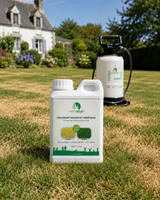
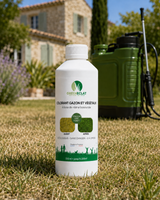
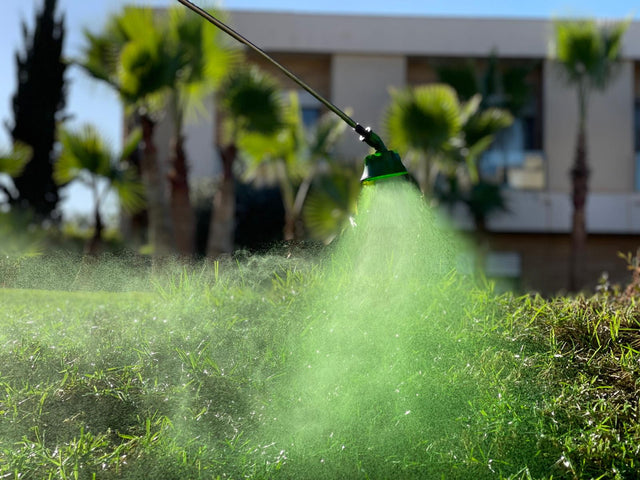
What is commonly called grass paint is in fact a colorant. Greeneclat is made of organic pigments, a 98% bio-based plant resin and water. It binds to the blades, which stay alive and keep growing, with no plastic film. The product dries in under 2 h in usual conditions, 2 to 3 h in summer, and the colour is set after 8 h without rain. The principle is explained on our page grass paint: what you need to know.
The colour lasts 2 to 3 months on a lawn and goes with the mowing. If the rain returns in the meantime, the new grass comes through green and takes over. Recolouring rather than watering: up to 80% less water on the treated areas (internal study).
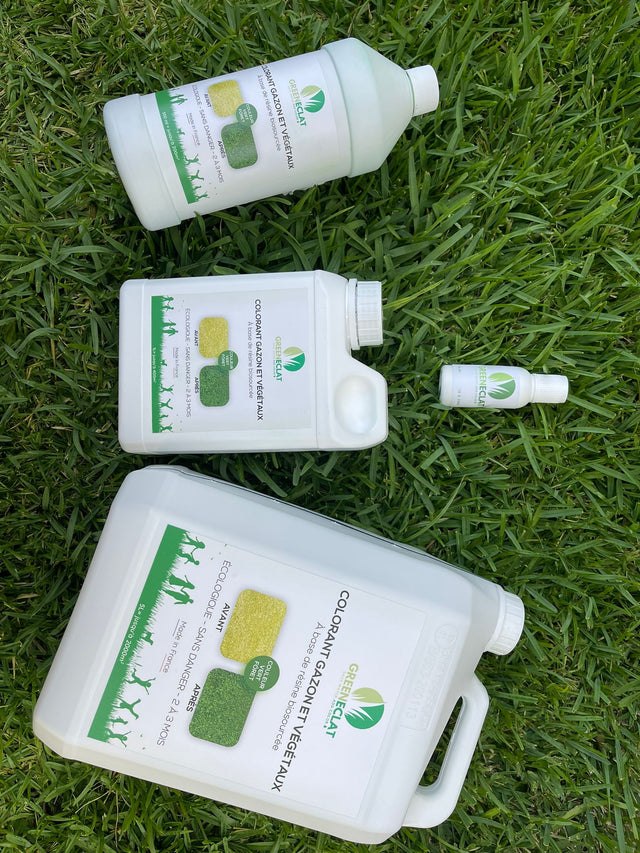
On budget, using the prices on the product pages: for 400 m² of healthy lawn, one 1 L concentrate at €89.99 is enough, or about €0.22/m². On a badly scorched lawn, coverage drops to 200 m² per litre: for 200 m², the same bottle works out at about €0.45/m². For a few patches, the 750 mL ready-to-use sprayer covers about 10 m² for €32.99. The comparison with overseeding or turfing is in the article lawn paint: what it costs per m².
Water: one to two weeks, if it is allowed
Iowa State University gives a precise method for bringing a lawn out of dormancy: 25 to 38 mm of water in a single application, that is 25 to 38 litres per square metre, then a second identical application 7 days later. The lawn starts to green up after the second watering. You then have to keep watering regularly, about 25 mm a week, or the lawn falls back into dormancy. The researchers advise precisely against moving it in and out of rest over the summer: only wake it up if you can keep the watering going.
Two limits weigh on this option. During a drought in France, the prefect can restrict lawn watering to certain hours, then ban it: check the order that applies to your address on the VigiEau website. And the RHS points out that an established lawn does not need this water to survive: it turns green again on its own when the rain returns. Watering an established lawn is therefore watering for appearance.
Wait for rain: the most frugal option
On a well-established lawn, the roots stay alive and send up new leaves as soon as the rain returns, according to the RHS. In the meantime, mow less often and higher, leave the clippings in place to keep moisture in the soil, and stop mowing if the grass is no longer growing. Limit foot traffic too: according to Iowa State University, moderate or heavy trampling damages the crowns of a dormant lawn, which may then struggle to recover.
If nobody is going to look at your lawn before autumn, this is the right answer. It costs nothing, and the lawn gets its colour back with the first regular rain.
Lay turf or reseed: for dead areas
Turf gives a green lawn on the day it is laid. The RHS recommends it when you need a usable lawn quickly: it can be enjoyed a few weeks later. It does, however, need prepared soil, turves laid within 24 h of delivery, and the right season: from mid-autumn to early spring, when the soil is neither waterlogged nor frozen. From mid-spring to early autumn, the RHS advises against it, because turves root poorly in hot weather and need repeated watering. Turf also costs more than seed.
Sowing is cheaper and slower. Seeds germinate in 7 to 10 days in early autumn or mid-spring. On a reseeded dead area, Iowa State University allows 2 to 4 weeks to see green again, then longer for the colour and texture to blend with the rest. The RHS advises using a new lawn as little as possible for about eight months. After a dry summer, autumn is the ideal time to overseed, with a drought-tolerant seed mix.
Combine: green now, a repaired lawn later
In many gardens, the right answer mixes the options. Take a lawn that has yellowed by late July, with a few dead patches, and a party planned in ten days. Watering would be too slow, or banned. Recolour the living grass a few days before the date, then reseed the dead patches in autumn, when the weather turns cool and damp again. The colour will go with the mowing while the lawn rebuilds itself. Our article drought-burnt lawn: recover it or recolour it sets out this timetable after a dry summer.
If you do not yet know why your lawn has turned yellow (drought, dog urine, mowing too short, grubs), start with the diagnostic table in the article yellow lawn: causes and fixes. A cause left unresolved will bring the yellow back.
What colour does not do
A colorant changes the appearance of the existing blades and nothing else. It does not make grass grow back, does not fill in a thin area and replaces neither sowing nor turf. It treats no disease and has no effect on grubs. Greeneclat is not a fertiliser, a weedkiller, a biostimulant or a plant protection product. Nor does it replace the water that a lawn sown or turfed within the year needs in order to root. Bare soil, moss and dead grass stay as they are.
Frequently asked questions
How do I get a green lawn in 24 hours?
By recolouring it, if the grass is still alive. The colorant dries in under 2 h in usual conditions (2 to 3 h in summer) and needs 8 h without rain after application. Turf also gives green as soon as it is laid, but it replaces the lawn and needs prepared soil and the right season; watering and sowing take one to several weeks.
How long does a recoloured lawn stay green?
Two to three months on a lawn. The colour goes with the mowing, which cuts off the coloured blades. If the rain returns in the meantime, the new grass grows with its own colour and takes over.
Can I recolour now and reseed later?
Yes, and it is often the right calculation. Recolour the living grass to get green straight away, then reseed the dead areas in spring or autumn, when the weather is cool and damp. The colorant is not applied to bare soil: the gaps still need overseeding.
Should I water a lawn after recolouring it?
Not during the 8 h after application: water would wash out part of the colour. After that, the colour is set. According to the RHS, an established lawn does not need watering to survive the summer; a lawn sown or turfed within the year does.
The size for an average lawn
The 1 L Meadow Green concentrate covers up to 400 m² of healthy lawn, or 200 m² of badly scorched lawn, with free delivery from 1 L (France) and dispatch within 48 h. For a very yellow lawn, choose the Forest Green version, deeper and more corrective. Send us a photo of your lawn by WhatsApp or through the contact page: we will tell you the right shade and dilution.