Buying grass paint: the criteria for choosing the right product

To choose grass paint, compare six points: what binds the pigments (the binder), the hazard label, the coverage per m² for the state of your grass, the shade, the stated durability and the format. What is called grass paint is in fact a colorant: the blades stay alive and the colour goes with the mowing.
This guide is for comparing what is on offer before you buy, and for checking that this type of product really solves your problem. For the principle of recolouring, its uses and how it works, see our page grass paint: the complete guide.
What you are buying under the name grass paint
The practice spread in the United States, where golf courses and sports grounds recolour their turf during dormancy. Turf researchers at North Carolina State University sort these products by their binder content, the material that sticks the pigments down. A paint in the strict sense contains 10 to 40% binder and, once dry, becomes a solid, opaque layer. Lawn products sit somewhere between that and pigments with almost no binder, which last only a week or two.
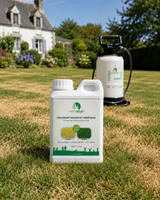
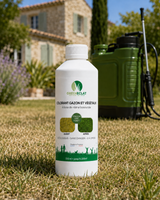
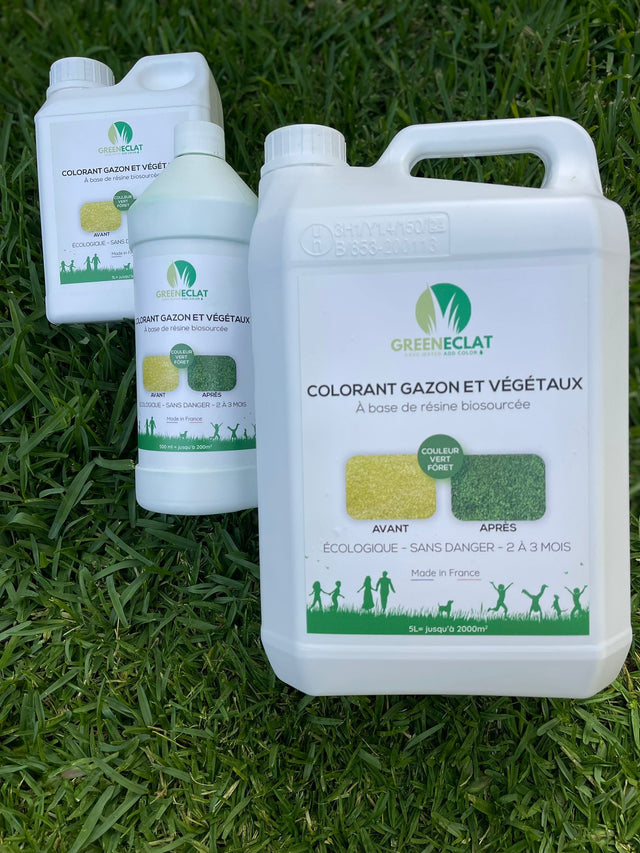
On a lawn, the useful question is therefore what the product leaves on the blade. Greeneclat is made of organic pigments, a 98% bio-based plant resin and water. The resin binds the pigments to the leaf without forming a plastic film: the grass keeps living and growing, and the coloured part is removed when you mow. We go into this in the article lawn paint or lawn colorant: the difference.
What the product should do on your lawn
The diluted colorant settles on the visible part of the blades. The colour appears as soon as the sprayer passes and sets as it dries, in under 2 hours in usual conditions (2 to 3 hours in summer). Allow 8 hours without rain after application: after that, showers and watering no longer wash it off.
The result depends a lot on the starting point. Trials at North Carolina State University show that turf that is still partly green gives a more convincing result than straw-coloured turf. That is why the dilution changes with the condition of the grass: the yellower the grass, the more concentrated the mix.
Before you buy: check that your grass is alive
A colorant recolours what is there. You need blades of grass, even yellow ones. The Royal Horticultural Society points out that an established lawn turns brown and stops growing during a drought, but that its roots generally stay alive and it greens up again when the rain returns. In that case, recolouring makes sense if you do not want to wait. If in doubt, start with the dead or dormant grass test.
Where the soil is bare, overrun by moss or torn up, there is nothing to recolour: you need to overseed or reseed, preferably in spring or autumn according to the same source.
Buy or not: the other options for a yellow lawn
| Option | When it fits | What it takes |
|---|---|---|
| Wait | Lawn dormant in summer, no particular deadline | Accepting a yellow garden for a few weeks |
| Water | When watering is allowed where you live | Water, often drinking water, for a result that is about appearance |
| Overseed or reseed | Bare soil or dead grass | Preparing the soil, sowing in the right season, waiting for growth |
| Recolour | Grass yellowed but present, need for a quick result | One application and 8 hours without rain |
Waiting remains the most frugal option, and it is often enough. Watering, for its part, can be restricted and then banned for lawns when the prefect issues a drought order, according to the French government's official pages on drought management. Recolouring rather than overwatering is more ecological than excessive watering: up to 80% less water on treated areas (internal study).
The 6 criteria for choosing grass paint
- What binds the pigments. Ask what the binder is. It makes the difference between a covering layer and a colorant that lets the blade live. At Greeneclat, it is a 98% bio-based plant resin.
- The label. Look for hazard pictograms. For Greeneclat: no pictogram, no CLP classification element, a safety data sheet free of any hazard, available on request.
- The real coverage. Compare the cost per square metre covered, not the price per litre. One litre of Greeneclat concentrate covers 400 m² of healthy lawn and 200 m² of badly burnt lawn. With the litre at €89.99 over 400 m² of healthy lawn, our calculator gives €0.22/m² including VAT. As a rough guide, allow €0.20 to €0.30/m² with concentrate for a household and around €1/m² with ready-to-use.
- The shade. A green that is too blue stands out. The North Carolina researchers observed that some products turn bluer as they age, because yellow pigments are less stable. Greeneclat comes in two shades, Meadow Green and Forest Green, which can be mixed: our guide which shade to choose helps you decide.
- The stated durability and what makes it vary. A duration with no explanation means nothing. On a lawn, mowing sets the limit: two to three months with ours.
- The format. A ready-to-use sprayer for a few spots, a 5 L ready-to-use container for a small garden (about 50 m²), a concentrate as soon as the area grows.
What application will ask of you
Mow and remove debris. Protect paths, patios and fences: these products stain hard surfaces, sometimes for good. Shake the container and dilute according to the state of the lawn: 1:30 for badly burnt, bleached or dormant turf, 1:40 for moderately damaged turf, 1:50 for turf that is still green or a young lawn. Spray in criss-cross passes. Two light passes give a more accurate result than one heavy pass. Keep children and pets away during application and drying. The full step-by-step is in our article how to paint a yellowed lawn: step by step.
What you are not buying with a colorant
A colorant acts on the colour of existing blades, and only on that. It does not make grass grow back and replaces neither seeding nor turfing. It is not a fertiliser, a weedkiller, a biostimulant or a plant protection product, and it treats no disease. It does not stop new dog urine spots from appearing. It is for living turf, hedges and evergreen shrubs: vegetable patches, edible or flowering plants, soil, mulch, moss and dead plants are excluded.
Frequently asked questions
How do I compare two grass paints?
Bring each price back to the square metres actually covered in the state your lawn is in, then look at the label (hazard pictograms), the type of binder and the stated duration with what makes it vary. The price per litre alone does not allow a comparison: one litre of Greeneclat concentrate covers 400 m² of healthy lawn, whereas a 750 mL ready-to-use sprayer covers about 10.
Is Greeneclat a paint?
No. Greeneclat is a colorant: the blades stay alive and keep growing, with no plastic film. It is made of organic pigments, a 98% bio-based plant resin and water. Grass paint is the term people type into search engines, which is why we use it in this article.
How long does the colour last on a lawn?
Two to three months on a lawn, because the colour goes with the mowing. On a hedge, a thuja or a boxwood, allow six to twelve months. After application, allow 8 hours without rain: after that, the colour is set.
Do I need special equipment?
For a few spots, the 750 mL ready-to-use sprayer is enough. Beyond that, a pressure garden sprayer with a fan nozzle lets you dilute the concentrate and work in even, criss-cross passes.
Which format to choose
For a lawn of a few hundred square metres, the 1 L Meadow Green concentrate covers up to 400 m² of healthy lawn, at €89.99, with free delivery from the 1 L (France) and dispatch within 48 hours. Torn between two shades or two dilutions? Send us a photo of your lawn: we will reply with the right shade, format and dosage.