How to measure your lawn area: 3 methods and online tools

To measure your lawn area, split it into simple shapes: rectangles (length × width), triangles (base × height ÷ 2) and circles (3.14 × radius × radius). Add them up, then subtract the patio, beds and paths. For an irregular shape, trace the outline on an online map such as cartes.gouv.fr or Google Earth, which display the area.
What you need
- A 20 or 30 m tape measure, or a builder's surveying tape. A dressmaker's tape or a folding rule soon makes measuring tedious.
- A few pegs or stones to mark the corners.
- A sheet of paper, ideally squared, to sketch the plan freehand and note each measurement.
- Without a tape, your paces, once calibrated: walk over 10 measured metres and count. If you take 13 paces, one pace is about 0.77 m, and 20 paces make about 15.4 m.
Measure with two people if possible: one holds the zero end of the tape, the other reads the measurement. Keep the tape flat and taut, just above the grass.
The useful formulas
| Shape | Formula | Example |
|---|---|---|
| Rectangle or square | length × width | 15 m × 8 m = 120 m² |
| Triangle | base × height ÷ 2 | 8 m × 6 m ÷ 2 = 24 m² |
| Circle | 3.14 × radius × radius | radius of 4 m: about 50 m² |
| Semicircle | area of the circle ÷ 2 | radius of 4 m: about 25 m² |
| Trapezium (two parallel sides) | (long side + short side) ÷ 2 × height | (10 m + 6 m) ÷ 2 × 9 m = 72 m² |
The height of a triangle or trapezium is measured at a right angle to the base, not along a sloping side. The radius is half the diameter: measure the width of the circle through its middle, then divide by two.
Method 1: split the garden into simple shapes
This is the most reliable method for a garden with straight edges. Draw the lawn seen from above, split it into rectangles and triangles, measure each piece, then add them up. Finally, subtract whatever is not grass.
Two examples. A rectangular lawn of 15 m by 8 m is 120 m²; with a 4 m by 3 m patio on it, 108 m² of grass remain. An L-shaped lawn splits into two rectangles: 12 m by 10 m, that is 120 m², plus 6 m by 5 m, that is 30 m², total 150 m². If there is a round bed of 1.5 m radius in the middle, about 7 m², the lawn is about 143 m².
Method 2: strips, for curved edges
A lawn with rounded edges does not split well into rectangles. Measure its length, then its width every 5 m, from one end to the other. Average the widths and multiply by the length. Over 20 m in length, with widths of 6 m, 7.5 m, 8 m, 7 m and 6.5 m, the average width is 7 m: the lawn is about 140 m². The closer together the measurements, the more accurate the result; every 2 or 3 m for a very winding shape.
Method 3: measure on an online map
For a large lawn or a complicated shape, an aerial view saves time. Three free tools let you trace an outline and read its area:
- cartes.gouv.fr, the French public map portal run by IGN, the national mapping agency, which now brings together the Géoportail services. Its "Measure an area" tool works like this: one click per corner of the lawn, a double click to close the shape, and the area is displayed in real time. If the tool does not appear, add it from the viewer's tool catalogue.
- Google Earth, on a computer: click Measure, place the points, then join the last one to the first to close the shape; the area is shown on the right. Google warns that its measurements are not necessarily 100% accurate where there is terrain relief or 3D buildings, and recommends the top-down view.
- cadastre.gouv.fr: on the French land registry map, the Measure tool offers an Area icon; you click on at least three points to form a polygon, and the area appears below the map.
Bear in mind the limits of an aerial view: the photo is not necessarily recent, a tree or a hedge can hide the edge of the lawn, and a patio built since will not appear. Check one or two measurements with the tape on site.
What to subtract from the calculation
If you are measuring in order to recolour, count only the grass to be treated. Subtract the patio, paths, beds, vegetable patch and flowering plants, which must not be coloured. Subtract bare soil and moss too: a colorant recolours only living grass. If only a few yellow spots are the problem, count them rather than measuring the lawn: the 750 mL ready-to-use sprayer treats more than 100 urine spots. Our article dog urine spots on the lawn covers this case.
For a hedge, you do not measure a ground area but the area of the foliage: the formula is in the article mentioned below.
From area to quantity of colorant
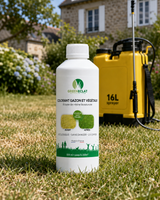
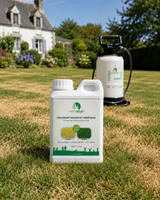
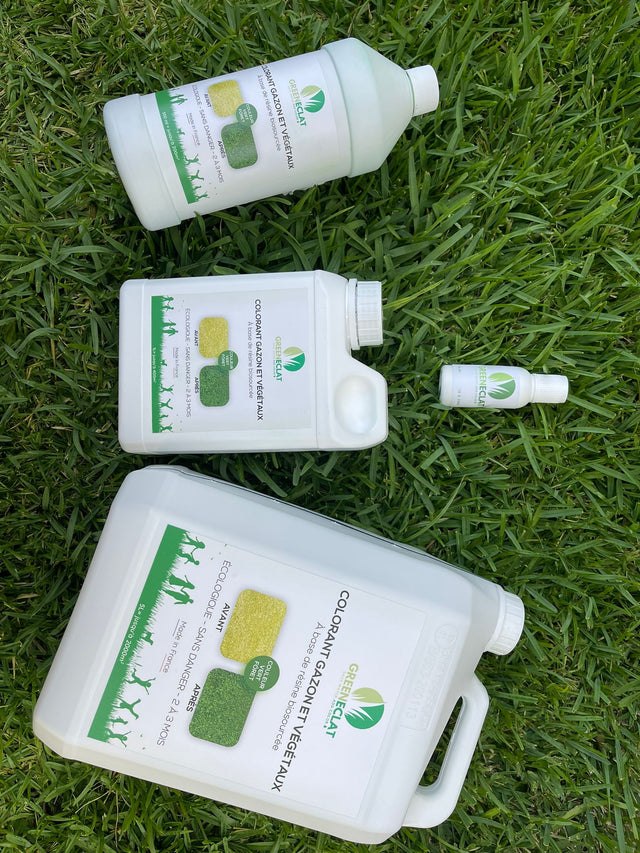
Whether you are looking for a grass paint or a colorant, the calculation starts from the same area. Greeneclat is a colorant, made of organic pigments, a 98% bio-based plant resin and water. One litre of concentrate covers 400 m² of healthy lawn and 200 m² of badly scorched lawn. With our examples and the prices on the product pages:
- 108 m² of lawn that is still green: one 500 mL concentrate at €69.99.
- 143 m² of lawn that is still green: the same 500 mL bottle is enough.
- 143 m² of badly scorched lawn: one 1 L concentrate at €89.99.
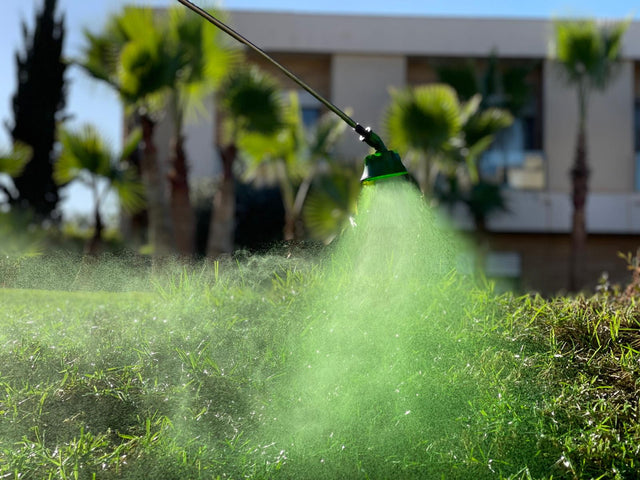
The full calculation, with common areas, hedges and the cost per m², is in the article how much colorant for my lawn. For speed, the calculator on the home page suggests a size based on your area. Before applying, our guide to painting your lawn goes over the dilution and the criss-cross passes; allow 8 h without rain after application.
Frequently asked questions
How can I measure my lawn without a tape measure?
With your paces, once calibrated: walk over 10 measured metres and count your paces. If you take 13, one pace is about 0.77 m. Or trace the outline of the lawn on cartes.gouv.fr or Google Earth, which display the area in m²; then check the edges on site.
Should I count the beds, paths and patio?
No. Measure only the grass you want to treat. Subtract from the total the patio, paths, beds, vegetable patch and any areas of bare soil or moss, which a colorant does not recolour.
Does the land registry give the area of my lawn?
The area of a land registry plot includes the house, the paths and all the rest of the property: it tells you nothing about the lawn alone. On the other hand, the Measure tool on cadastre.gouv.fr lets you trace a polygon on the map and read its area.
How accurate do I need to be to order colorant?
To the nearest square metre is more than enough. The sizes cover areas in steps (200 m² for a 500 mL concentrate on a healthy lawn, 400 m² for a 1 L): round your total up and keep a little margin for touch-ups.
The size for a town garden lawn
Up to 200 m² of healthy lawn, the 500 mL Meadow Green concentrate is the simplest size, at €69.99, dispatched within 48 h. Beyond that, or if the lawn is very yellow, move up to the 1 L concentrate, with free delivery from 1 L (France). Send us your plan or a photo by WhatsApp or through the contact page: we will check the quantity with you.